




Website hosting is one of those terms that gets thrown around constantly, yet most small business owners have only a vague sense of what it actually involves. If you’ve ever wondered what does website hosting mean beyond “somewhere my website lives,” you’re not alone. The good news is that understanding hosting doesn’t require a tech degree. It does, however, require a clear explanation, because the hosting decisions you make now will shape how your website performs, how secure it is, and whether customers can actually find you online.
Table of Contents
- Key takeaways
- What does website hosting mean, exactly?
- Types of website hosting services
- How hosting affects your online presence
- Common pitfalls when choosing a host
- Getting started with website hosting
- My honest take on hosting for small businesses
- Ready to get your website online with Com?
- FAQ
Key takeaways
| Point | Details |
|---|---|
| Hosting stores your website files | A web host keeps your site’s data on a server so visitors can access it anytime via your domain name. |
| Hosting type affects performance | Shared, VPS, cloud, and dedicated hosting each suit different business sizes and budgets. |
| Speed and uptime matter | The host you choose directly influences how fast your site loads and how often it stays online. |
| “Unlimited” claims need scrutiny | Many hosting plans advertise unlimited resources but hide usage restrictions in the fine print. |
| Local support makes a difference | For Australian businesses, choosing a provider with local expertise simplifies setup and ongoing management. |
What does website hosting mean, exactly?
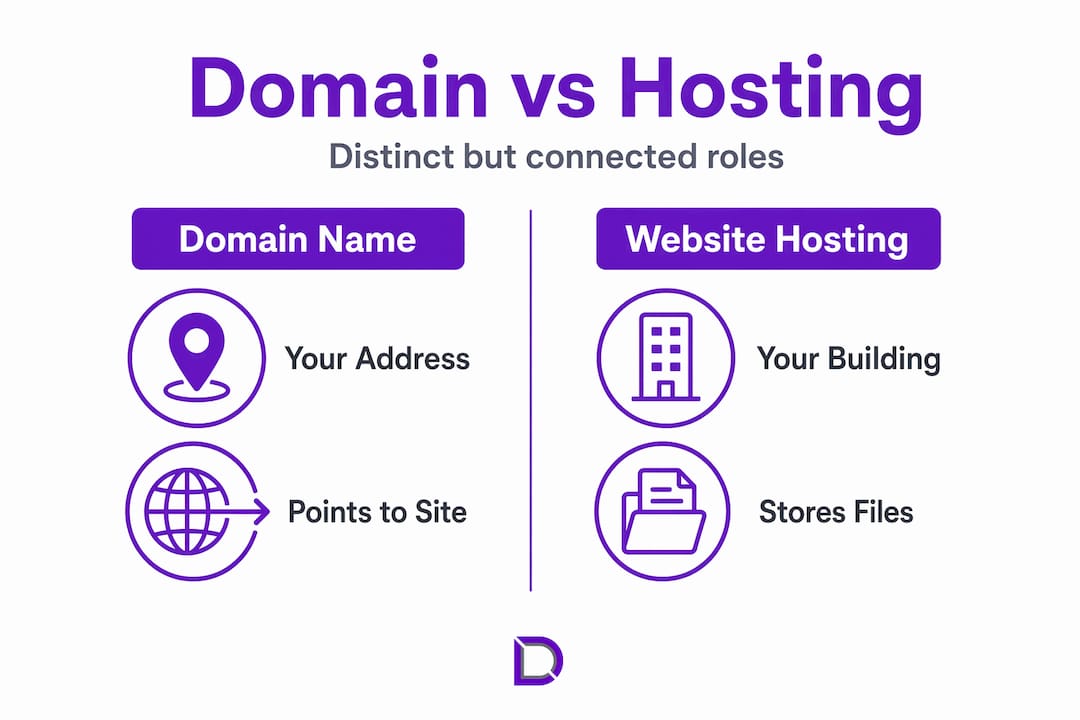
Think of your website as a physical shop. The domain name is your street address, and the hosting is the building itself. Website hosting stores files on servers and delivers that content to visitors when they type your domain name into a browser. Without hosting, there is nowhere to put those files, and your domain name points to nothing.
Here is how it works behind the scenes. When someone types your web address, the Domain Name System (DNS) translates that domain into the server’s IP address. The server then retrieves your website’s files, including images, text, and code, and sends them back to the visitor’s browser within fractions of a second. This happens every single time someone visits your site.
Your hosting plan also covers more than just storage. Reputable providers handle ongoing tasks that keep your site running:
- Software updates to keep your content management system and plugins current
- Automated backups so you can restore your site if something goes wrong
- Security monitoring to detect and respond to threats before they cause damage
- Technical support for when things stop working as expected
The relationship between your domain name and your hosting is worth understanding clearly. You can register a domain through one provider and host your website through another, though keeping both under one roof usually simplifies management considerably.
Types of website hosting services
Not all hosting is created equal. The right type depends on your budget, your expected traffic, and how much technical control you want. Here is a breakdown of the main options.

| Hosting type | Best for | Approximate cost | Key trade-off |
|---|---|---|---|
| Shared hosting | New sites, personal blogs | Under $10/month | Resources shared with other sites |
| VPS hosting | Growing businesses | $20–$80/month | More control, requires some technical know-how |
| Dedicated hosting | High-traffic, resource-heavy sites | From ~$100/month | Maximum performance, highest cost |
| Cloud hosting | Businesses needing flexibility | Variable | Scales easily, pricing can fluctuate |
| Managed WordPress | WordPress site owners | $15–$50+/month | Optimised for WordPress, less manual effort |
Shared hosting puts several websites on one physical server, which keeps costs low but means you share resources like bandwidth and processing power with your neighbours. For a new business or personal site with modest traffic, it is a perfectly reasonable starting point.
VPS hosting gives you a virtual private environment within a shared physical server. Think of it like renting a flat in an apartment building: you have your own locked space with dedicated resources, even though the building itself houses multiple tenants. It is a significant step up in performance and reliability.
Dedicated hosting reserves an entire physical server for your site alone. The cost reflects that exclusivity, starting at around $100 per month and rising steeply with more powerful configurations. It suits large e-commerce stores or platforms with heavy, consistent traffic.
Cloud hosting distributes your site across multiple servers in different locations, which improves both reliability and the ability to scale quickly during traffic spikes. If one server has an issue, others pick up the load seamlessly.
Managed WordPress hosting is tailored specifically for WordPress sites. The provider handles updates, security patches, and performance optimisation automatically, freeing you from technical maintenance. Com’s WordPress hosting plans are built with exactly this kind of convenience in mind for Australian businesses.
Pro Tip: If you are just starting out, shared hosting is fine. But if you expect growth within twelve months or plan to sell products online, start with VPS or managed WordPress hosting to avoid a disruptive migration later.
How hosting affects your online presence
Choosing the right type of hosting is one decision. Choosing a quality provider within that type is another. The hosting infrastructure beneath your website has a direct impact on four things that matter enormously to small businesses: uptime, speed, security, and scalability.
Uptime is how often your website is actually available to visitors. Most reputable providers guarantee 99.9% uptime, which sounds close to perfect but still amounts to roughly eight hours of potential downtime per year. Cheap or overcrowded shared servers often fall short of that figure, which means visitors get error pages instead of your business.
Speed has become non-negotiable. NVMe SSD storage is now considered the baseline for any serious website, offering dramatically faster data retrieval than traditional hard drives. Slow loading times frustrate visitors and harm your position in search results.
Security varies significantly between providers. Basic hosts may only alert you when malware is detected, while premium providers carry out server-level scans and automated cleanup. For a business website handling customer data or payments, the difference is significant. Pairing strong hosting with dedicated security tools adds another layer of protection.
Scalability means your hosting can grow as your business does. The benefits of choosing a quality host from the start include:
- Faster page load times that keep visitors on your site longer
- Consistent availability so customers can reach you around the clock
- Automated security features that protect customer data
- Easy upgrades as your traffic and storage needs increase
- Local or responsive support when something needs fixing quickly
Pro Tip: Ask any prospective host specifically about their backup frequency, restoration process, and average support response time before you commit. These three factors reveal far more about real-world reliability than the headline uptime percentage.
Common pitfalls when choosing a host
Understanding website hosting also means understanding where people go wrong. These mistakes are common, and most of them are avoidable with a little preparation.
-
Taking “unlimited” plans at face value. Unlimited hosting claims almost always come with hidden restrictions buried in the terms of service. Exceeding undisclosed limits on file numbers, CPU usage, or data can get your account suspended without warning.
-
Ignoring renewal pricing. Many hosts offer attractive introductory rates that jump sharply when the initial term expires. Introductory prices are often not what you will pay in year two or three. Read the renewal rate, not just the sign-up price.
-
Choosing purely on cost. Cheap hosting tends to mean overcrowded servers, minimal support, and poor security. For a business that depends on its website to generate enquiries or sales, the cost of downtime or a security breach far exceeds the savings from a bargain plan.
-
Overlooking managed services. Many business owners assume they will handle updates and backups themselves, then never get around to it. Managed hosting removes that risk entirely and is worth the extra monthly investment for anyone without dedicated IT support. Pairing your hosting with professional IT solutions can also strengthen your overall digital infrastructure.
-
Forgetting to read the cancellation terms. Some providers make it surprisingly difficult to migrate away or obtain a refund. Check the exit process before you sign up, not after you decide to leave.
Getting started with website hosting
Setting up your first hosting account does not need to be complicated. Here is a practical path forward for individuals and small business owners.
- Choose your domain name first. Your domain is your business address online. Use domain management tools to check availability and register your preferred name before you do anything else.
- Select a hosting plan that matches your current needs, not your hypothetical future traffic. You can always upgrade.
- Read the fine print on storage limits, email accounts, SSL certificate inclusion, and support hours before signing.
- Upload your website files or use a website builder. Most modern hosting plans include one-click installers for WordPress and other popular platforms, making this step far simpler than it sounds.
- Set up your DNS records to connect your domain to your hosting server. Your provider should walk you through this or handle it on your behalf.
- Check what complementary services you might need, such as professional website design to ensure your site looks credible alongside its technical foundation.
The setup process typically takes a few hours at most for a basic site. The decisions you make at this stage, particularly around hosting type and provider quality, will save you considerable headaches later.
My honest take on hosting for small businesses
I’ve seen small business owners agonise over their logo colours for weeks while spending five minutes picking a hosting plan. That order of priorities is backwards, and it costs them.
In my experience, the hosting decision is where I’ve watched businesses quietly lose customers without ever knowing why. A site that loads slowly on mobile, goes down during peak hours, or gets compromised by malware does real damage. The visitors who bounce never leave a review complaining about it. They just don’t come back.
What I’ve found works well for most people starting out is managed WordPress hosting with a reputable local provider. You get the performance benefits without needing technical expertise to maintain it. As businesses scale, a move to cloud or VPS hosting makes sense, but it rarely needs to happen immediately.
The single most common mistake I’ve seen? Choosing a host based on a promotional price and discovering the support is unhelpful, the server is sluggish, and the renewal cost is double the original rate. Getting local support from a provider who actually understands the Australian market makes an enormous practical difference, particularly when something goes wrong at an inconvenient time.
Start with quality. The few extra dollars per month are worth it.
— James
Ready to get your website online with Com?
Com is an Australian provider offering hosting and domain solutions built for individuals and small business owners who want reliable performance and real local support. Whether you are setting up your first website or moving an existing one to a better host, the team at Com makes the process straightforward.
Com’s web hosting plans cover shared and managed options suited to a range of budgets and business sizes, and WordPress hosting is available for anyone running their site on that platform. You can also manage your domain name in the same place, keeping everything under one roof and reducing the complexity of your online setup. If you are ready to take the next step, explore Com’s hosting and domain services at distribute.com.au.
FAQ
What does website hosting mean in simple terms?
Website hosting is a service that stores your website’s files on a server so people can access your site online. When someone types your domain name, the host delivers those files to their browser.
What is the difference between a domain name and hosting?
A domain name is your website’s address (for example, ), while hosting is the server where your website’s actual files are stored. You need both for a website to work.
What type of hosting suits a small business?
Shared or managed WordPress hosting suits most small businesses starting out, offering a good balance of affordability and performance. As your traffic grows, VPS or cloud hosting provides more resources and reliability.
Are “unlimited” hosting plans actually unlimited?
Not entirely. Unlimited hosting plans typically include restrictions on CPU usage, file numbers, or data that can lead to account suspension if exceeded. Always read the terms of service carefully.
How does hosting affect my website’s search ranking?
Slow load times and frequent downtime can negatively affect your position in search results. NVMe SSD-powered hosting delivers the speed and reliability that search engines favour and visitors expect.
Leave a Reply