




A domain registrar is an accredited company that manages the reservation of domain names on behalf of individuals and businesses, acting as the administrative link between you and the domain registry. Without a registrar, there is no way to claim a domain name, configure it, or keep it active over time. For Australian small business owners, understanding how domain registrar works is the difference between confidently controlling your online presence and being at the mercy of processes you do not understand. This guide explains the domain registration process from start to finish, clarifies the roles of registrars versus registries and hosting providers, and gives you practical criteria for choosing a registrar that suits your needs.
How does the domain registration process work?
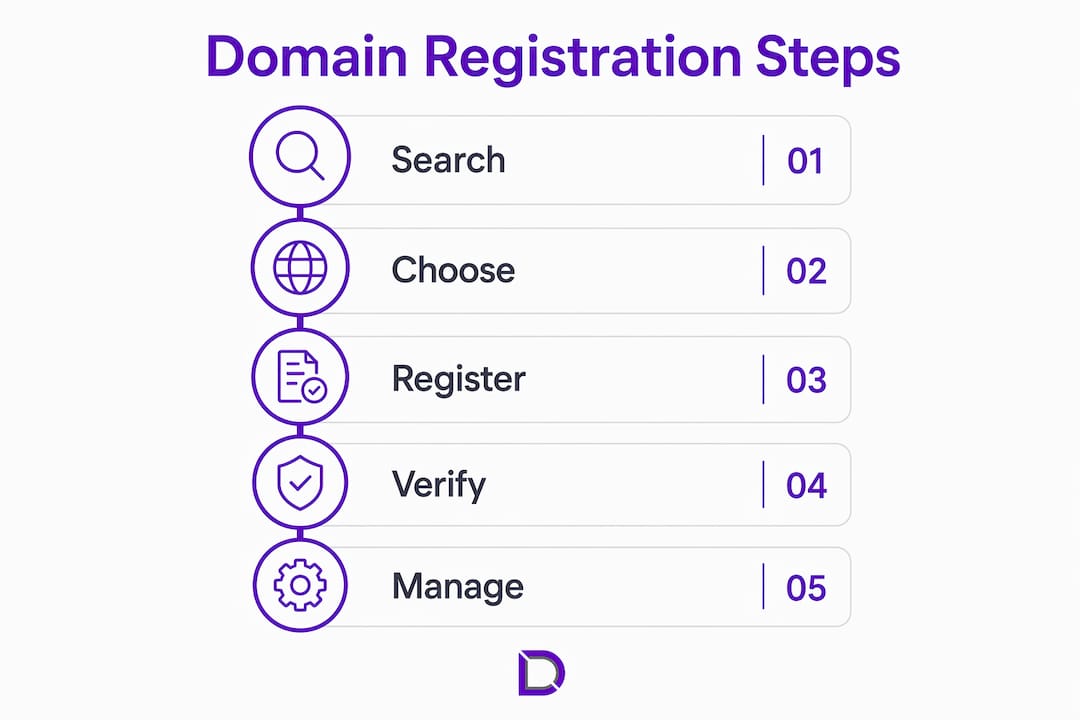
The domain registration process follows a clear sequence of steps, and most registrars complete it in under a few minutes once you reach the checkout stage. Knowing each step removes the guesswork and helps you avoid common mistakes.
-
Search for availability. Enter your preferred domain name into the registrar’s search tool. The registrar queries the relevant registry database in real time to confirm whether the name is taken or available.
-
Select your domain and registration term. Most top-level domains (TLDs) can be registered for up to 10 years. Choosing a longer term reduces the risk of accidental expiry and often works out cheaper per year.
-
Enter your contact details. Registrars collect four categories of contact information: Registrant (the legal owner), Admin (the person managing the domain), Technical (responsible for DNS settings), and Billing (for renewal payments). These details are stored in the registry’s database and are used to verify ownership.
-
Verify and confirm. Most registrars send a verification email to the registrant address. Clicking the link confirms your identity and activates the registration.
-
Access your domain management dashboard. Once registration is complete, you can log in to your registrar’s control panel to configure nameservers, set up domain locks, and manage renewals. Some registrars, including those using modern infrastructure, complete this entire workflow in about 30 seconds after checkout.
Pro Tip: Use a business email address as your registrant contact, not a personal one. If staff change or personal accounts are closed, you risk losing access to critical renewal notices and ownership verification requests.
The steps to register a domain are straightforward, but the details matter. A misspelled contact email or an overlooked verification step can delay your domain going live or create complications during a future transfer.

How do registrars manage renewals, transfers, and DNS?
Once a domain is registered, the registrar’s job is far from over. Registrars serve as the customer-facing interface for the entire domain lifecycle, coordinating renewals, transfers, and DNS delegation with the registry behind the scenes.
Renewals are the most time-sensitive responsibility. Because domain registrations are leases rather than permanent purchases, failing to renew before the expiry date means your domain enters a grace period and then becomes available to anyone. Most registrars send reminder emails, but relying solely on those is risky. Set a calendar reminder 60 days before your renewal date as a backup.
Transfers between registrars are governed by ICANN rules and typically take about five days to complete. The process requires an authorisation code (also called an EPP code or transfer key) from your current registrar. Common pitfalls include:
- Forgetting to unlock the domain before initiating the transfer
- Having outdated registrant contact details that delay the authorisation email
- Assuming the transfer automatically updates your DNS settings (it does not)
That last point is worth emphasising. Transferring your registrar does not change your DNS hosting, which means your website and email continue to point wherever they were configured before. You must deliberately update nameserver settings after a transfer if you want DNS to change.
DNS delegation is the process by which your registrar tells the internet which nameservers are authoritative for your domain. When someone types your domain into a browser, the DNS system queries those nameservers to find your website’s IP address. Most registrars provide a control panel where you can update these records yourself, though the actual website files sit on a separate hosting server.
Pro Tip: After any DNS change, use an RDAP query tool to verify your domain’s live status. RDAP is replacing WHOIS as the standard for querying registration data, providing structured and more reliable results than the older system.
What should you look for when choosing a domain registrar?
Choosing a domain registrar is not just about finding the cheapest first-year price. Operational control throughout the domain lifecycle depends on registrar responsiveness and accurate data maintenance, which matters far more than saving a few dollars upfront.
The table below compares the key factors to weigh when evaluating trusted domain registrars.
| Factor | What to look for |
|---|---|
| Accreditation | Confirm the registrar is ICANN-accredited or, for Australian domains, authorised under auDA rules |
| Pricing transparency | Check renewal fees, not just first-year prices. Transfer fees should also be clearly disclosed |
| Security features | Look for domain locks, two-factor authentication, and private registration (WHOIS privacy) options |
| Management dashboard | A clear, responsive control panel makes DNS changes and renewals far less stressful |
| Customer support | Australian-based support with phone or live chat access is worth paying a small premium for |
| Bundled services | Some registrars offer DNS hosting, email, and web hosting in one place, reducing the number of providers you manage |
Accreditation is the non-negotiable starting point. In Australia, the .com.au and .net.au namespaces are governed by auDA (the .au Domain Administration), and registrars must be accredited under their framework. For generic TLDs like .com or .org, ICANN accreditation is the relevant standard. Registering with an unaccredited reseller adds a layer of complexity and risk to every future transfer or dispute.
Security features deserve more attention than most small business owners give them. A domain lock (also called a registrar lock or transfer lock) prevents unauthorised transfers. Without it, a compromised email account could be enough for a bad actor to initiate a transfer of your domain to another registrar. Enabling this lock costs nothing and takes seconds.
For a practical overview of what to consider when setting up your online presence, the business setup checklist from Com covers domain registration alongside other foundational steps.
How do registries, registrars, and hosting providers differ?
These three entities are distinct, but they work together every time someone visits your website. Confusing them leads to wasted time when something goes wrong.
The registry is the organisation that maintains the master database for a specific TLD. Verisign manages .com, for example, while auDA oversees .com.au. Registries maintain TLD databases and set the policies that registrars must follow. You never interact with a registry directly as a domain owner.
The registrar is the company you deal with. It takes your registration request, submits it to the registry, stores your contact details, and manages the ongoing lifecycle of your domain. The separation-of-duties model between registries and registrars exists to create accountability and prevent monopolistic control over the domain name system.
The hosting provider is an entirely separate entity. It stores your website’s files and serves them to visitors. Your registrar points your domain to your hosting provider via DNS, but the two services are independent. You can change your hosting provider without changing your registrar, and vice versa.
Here is how a typical website visit connects all three:
- A visitor types your domain into their browser
- The DNS system queries the nameservers your registrar has on record
- Those nameservers (often managed by your hosting provider) return the IP address of your web server
- The browser loads your website from that server
Understanding this flow is genuinely useful when something breaks. If your website goes down, the problem is almost always with the hosting provider or DNS settings, not the registrar itself. If your domain stops resolving entirely, check your registrar dashboard first to confirm the nameservers are correct and the domain has not expired.
For a deeper look at how domain names work in the context of small business, Com has a dedicated guide worth reading alongside this one.
Key takeaways
A domain registrar is the accredited intermediary that manages every stage of your domain’s life, from initial registration through renewals, transfers, and DNS delegation, making registrar choice and ongoing management critical to your online presence.
| Point | Details |
|---|---|
| Registrars manage the full lifecycle | Registration, renewal, transfer, and DNS delegation are all registrar responsibilities. |
| Domains are leased, not owned | Registrations last up to 10 years and must be renewed to maintain your rights. |
| Transfers take about five days | DNS settings do not change automatically during a transfer. Update them deliberately. |
| Accreditation is non-negotiable | Use an ICANN-accredited or auDA-authorised registrar to protect your domain rights. |
| Security locks prevent hijacking | Enable domain lock and two-factor authentication as soon as your domain is registered. |
What I have learned managing domains for Australian small businesses
Working with small business owners across Australia, I have seen the same mistakes repeated more often than I would like. The most costly one is treating domain registration as a one-time task. You register the domain, forget about it, and then receive a panicked call three years later because the domain expired and someone else grabbed it overnight.
The second mistake is choosing a registrar based purely on a first-year promotional price. A $2 domain that renews at $40 per year, with no local support and a clunky dashboard, costs you far more in time and stress than a fairly priced registrar with responsive Australian support. Operational control is the real measure of a registrar’s value.
I also see businesses neglect their registrant contact details after the initial setup. Contact data updates do not always propagate instantly, and stale details can block a transfer or delay ownership verification at the worst possible moment. Log in to your registrar dashboard at least once a year, confirm your contact details are current, and run an RDAP check to see what the live registry record shows.
The businesses I have seen manage their domains best treat the registrar dashboard the same way they treat their accounting software. It is not glamorous, but checking it regularly keeps everything running without drama.
— James
Ready to take control of your domain?
Managing your domain does not have to be complicated. Com provides Australian individuals and small businesses with straightforward domain registration and management services, including renewals, DNS delegation, and transfers handled by a team that understands the local market.
Whether you are registering your first domain or moving an existing one to a registrar with better support, Com’s web hosting and domain services give you everything in one place. Local support, transparent pricing, and a clean management dashboard mean you spend less time troubleshooting and more time running your business. Explore Com’s domain solutions to get started with confidence.
FAQ
What is a domain registrar?
A domain registrar is an accredited company that registers and manages domain names on behalf of individuals and businesses, acting as the intermediary between the registrant and the domain registry. Registrars handle registration, renewals, transfers, and DNS configuration throughout the domain’s life.
How long does domain registration take?
The domain registration process typically completes within minutes of checkout, with some registrar workflows processing a new domain in about 30 seconds. Verification emails may add a short delay if the registrant address needs to be confirmed.
Can I transfer my domain to a different registrar?
Yes. Domain transfers between registrars are governed by ICANN rules and generally take around five days to complete. You will need an authorisation code from your current registrar, and your domain must be unlocked before the transfer can proceed.
Does changing my registrar affect my website?
Changing your registrar does not automatically update your DNS settings, so your website and email should continue working as before. If you want DNS to point to a new provider after the transfer, you must update your nameserver settings deliberately in the new registrar’s dashboard.
How do I know if a domain registrar is legitimate?
Check that the registrar is ICANN-accredited for generic TLDs like .com, or authorised under auDA for Australian domains like .com.au. Legitimate registrars display their accreditation status clearly and provide transparent pricing for both registration and renewal fees.
Leave a Reply