




Choosing the wrong web hosting type is one of the most common — and costly — mistakes small businesses make online. Understanding what is shared vs dedicated hosting is not just a technical exercise; it directly affects how fast your site loads, how secure your customer data is, and whether your website can handle growth without falling over. Many Australian small business owners set up their first website without realising that not all hosting is equal, and that decision shapes everything from your Google ranking to your customers’ first impression.
Table of Contents
- What is shared hosting and how does it work
- What is dedicated hosting and who should consider it
- Comparing shared and dedicated hosting: costs, performance and security
- Maintenance, control and scalability: what to expect
- Choosing the right hosting for your small business website
- Why thinking beyond cost is critical when choosing hosting
- Explore reliable hosting options with Distribute Group
- Frequently asked questions
Key Takeaways
| Point | Details |
|---|---|
| Shared hosting basics | Shared hosting is affordable and easy to use but shares server resources among many websites, affecting performance. |
| Dedicated hosting benefits | Dedicated hosting offers exclusive resources, better performance, and higher security but at a higher cost. |
| Cost versus control | Choosing hosting involves balancing cost, technical expertise, control, and your site’s specific needs. |
| Scalability and maintenance | Shared hosting limits scaling and requires less upkeep, while dedicated hosting scales better but needs technical management. |
| Make informed choice | Assess your traffic, security, and growth plans to select hosting that aligns with your small business goals. |
What is shared hosting and how does it work
Shared hosting means your website lives on a server alongside hundreds, sometimes thousands, of other websites. Think of it like renting a room in a large apartment building. You share the electricity, water, and hallways with everyone else. If one tenant throws a party and maxes out the hot water, everyone else feels it. Your website works the same way — if another site on your server gets a traffic surge, your site can slow down too.
That said, shared hosting benefits are real and significant for the right type of business. The provider handles everything: server maintenance, security patches, software updates, and backups. You simply log in, usually via a control panel like cPanel, and manage your website content. No server knowledge required.
The cost reflects this simplicity. Shared hosting plans typically range from $2 to $20 per month, making it the most accessible entry point for small businesses launching their first website. For a local tradie, a café with a menu page, or a consultant building a portfolio, those numbers make real sense.
Key shared hosting benefits at a glance:
- Very low monthly cost, ideal for tight startup budgets
- No technical server management required from you
- Quick setup, often with one-click install for platforms like WordPress
- Includes tools like cPanel for managing email, files, and databases
- Hosting provider manages uptime monitoring and hardware
Pro Tip: When browsing web hosting options, look for shared plans that include SSL certificates and daily backups. These are often standard but worth confirming before you sign up.
Now that we understand how shared hosting works, let us explore the alternative: dedicated hosting.
What is dedicated hosting and who should consider it
Dedicated hosting means you rent an entire physical server exclusively for your website. No shared hallways, no shared utilities. It is more like owning your own house. You control the layout, the security system, the upgrades, and you never have to worry about what your neighbours are doing.

As dedicated hosting provides exclusive access to all physical server resources, you get optimal performance and a higher level of security by default. Every gigabyte of RAM, every CPU cycle, every thread of bandwidth belongs to your site alone. That translates to faster load times, consistent uptime, and the ability to customise your server environment to suit specific software requirements.
What is dedicated hosting suitable for in practice? Think large ecommerce stores processing hundreds of transactions daily, healthcare or legal platforms storing sensitive client data, or SaaS businesses running resource-heavy applications. These are environments where downtime costs real money and security is non-negotiable.
Dedicated hosting advantages worth knowing:
- Full resource allocation means no performance interference from other sites
- Root-level server access allows custom software installation and configuration
- Tailored security settings, including firewalls and compliance configurations
- Better suited for sites that handle sensitive customer or financial data
- Dedicated IP address, which matters for certain SSL configurations and email reputation
The cost of dedicated hosting reflects this level of exclusivity. Plans generally start around $80 per month and can climb well beyond $300 for high-specification servers. Before committing, make sure your domain management setup is sorted too, since moving to dedicated hosting often involves reassigning DNS settings and reviewing email server configurations.
Pro Tip: If you are considering dedicated hosting but are not sure about managing a server yourself, look for a managed dedicated plan. The provider handles the technical side while you retain the performance benefits. It costs more, but it removes a significant operational burden.
For a thorough detailed hosting comparison covering technical specifications, that resource is worth bookmarking.
Understanding the core differences helps, but let us compare shared and dedicated hosting side by side to clarify the trade-offs.
Comparing shared and dedicated hosting: costs, performance and security
Here is where the decision becomes concrete. Shared hosting costs range from $2 to $20 per month, while dedicated hosting starts around $80 and can exceed $300 monthly. That is not just a price gap — it reflects a completely different relationship with your server infrastructure.
| Factor | Shared hosting | Dedicated hosting |
|---|---|---|
| Monthly cost | $2 to $20 | $80 to $300+ |
| Resource access | Shared with many sites | Exclusive to your site |
| Performance consistency | Variable, affected by other users | Predictable, high performance |
| Security level | Basic, shared environment | Advanced, fully configurable |
| Technical management | Handled by provider | Requires skill or managed plan |
| Customisation | Limited | Full control |
| Best suited for | New, low-traffic websites | High-traffic, sensitive, or complex sites |
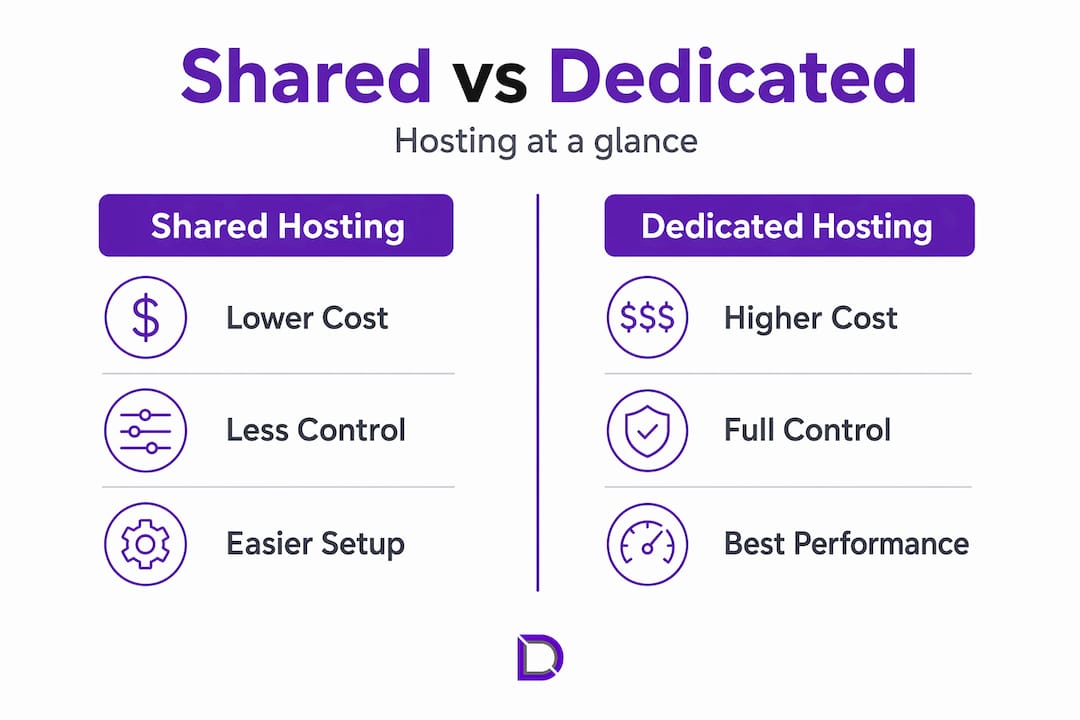
Performance is where the difference shows up most visibly. In a shared environment, one overloaded site can degrade the experience for every other site on that server. This is what hosting professionals call the “noisy neighbour” effect. Dedicated hosting eliminates this problem entirely, ensuring predictable, high performance with exclusive resources.
Security is the other major consideration. In a shared environment, if another website on your server gets compromised, that malware or breach can potentially spread. You are only as secure as the weakest site on your server. Dedicated hosting removes that exposure completely. You define the firewall rules, control who has access, and configure security policies to meet your specific requirements or industry standards.
Shared hosting drawbacks to factor in:
- Performance can drop without warning during traffic spikes on other sites
- Limited ability to install custom server-side software
- Security is partially dependent on other tenants’ practices
- Shared IP address can affect email deliverability if another site sends spam
If your business runs a content-heavy site or an online store, exploring WordPress hosting options built specifically for that platform may offer a middle ground worth considering. For businesses investing in a professional online presence, the quality of your website design and the reliability of your hosting need to work in tandem.
“When performance and security insights matter for mission-critical applications, dedicated infrastructure offers predictable costs and consistent performance that shared environments simply cannot match.”
Beyond these core differences, it is vital to understand the maintenance and scalability challenges each hosting type brings.
Maintenance, control and scalability: what to expect
This is where many small business owners get a surprise. Shared hosting requires almost no technical involvement from you. The provider manages the server, installs updates, monitors hardware, and handles security at the infrastructure level. Your job is to manage your website content, not the server it sits on.
Dedicated hosting is a different story. Unmanaged dedicated hosting requires you to handle OS updates, security patches, and server configurations yourself. That demands either in-house technical expertise or a budget for IT support. Many small businesses underestimate this when they compare hosting plans purely on price.
Scalability is another factor that rarely gets enough attention. Here is how each option handles growth:
- Shared hosting growth path: As your traffic increases, you will likely need to upgrade to a higher-tier shared plan or migrate to a different hosting type entirely. This process involves downtime risk if not handled carefully.
- Dedicated hosting growth path: A dedicated server gives you more headroom from the start, but eventually, scaling up means upgrading hardware, which can involve physical server migration.
- Watch the fine print on “unlimited”: Shared hosting “unlimited” claims are subject to fair use policies. In practice, if you consume significantly more resources than average users, your provider can throttle your site or ask you to upgrade.
- Managed dedicated options bridge the gap: If you want dedicated performance without the maintenance burden, managed plans let the provider handle the technical side while you focus on running your business.
- Plan migration timing: The best time to migrate from shared to dedicated hosting is before you hit the limits, not after your site has already started slowing down under load.
Pro Tip: Set a traffic benchmark with your current web hosting management dashboard. If your monthly visitors consistently exceed 10,000 or your site regularly hits resource usage warnings, that is a strong signal to evaluate an upgrade.
With these practical considerations in mind, let us examine how you can decide which hosting type fits your business goals and technical capacity.
Choosing the right hosting for your small business website
Getting this decision right comes down to an honest assessment of four things: your current traffic, your growth expectations, your security requirements, and your technical capacity. Most Australian small businesses starting out will find shared hosting is sufficient and sensible. The question is knowing when that changes.
Shared hosting suits low-traffic sites with basic needs, while dedicated hosting fits resource-intensive, high-traffic, or security-sensitive environments. That is the rule of thumb, but here is what it looks like in practice:
| Business type | Recommended hosting | Reason |
|---|---|---|
| Local service business or tradesperson | Shared | Low traffic, basic information site |
| Small retail with online catalogue | Shared or managed WordPress | Moderate needs, plugin-dependent |
| Growing ecommerce store (500+ orders/month) | Dedicated or VPS | Performance and transaction security |
| Healthcare, legal, or financial services | Dedicated | Compliance, data privacy requirements |
| SaaS or membership platform | Dedicated | Resource-heavy, always-on requirements |
Questions to ask before choosing:
- How many visitors do you expect per month — now and in 12 months?
- Does your site process payments or store sensitive customer data?
- Do you have the technical skills or budget to manage a server, or do you need the provider to handle it?
- Are you running resource-heavy software like a membership platform or video streaming?
- How much downtime can you actually afford before it affects revenue?
Sorting your domain services early also matters here. Your domain registrar and hosting provider do not have to be the same company, but having them in one place simplifies DNS management significantly, especially when migrating between hosting types.
Now that you know how to evaluate your needs, here is our perspective on the shared vs dedicated hosting decision for Australian small businesses.
Why thinking beyond cost is critical when choosing hosting
Cost dominates the conversation when small business owners compare hosting types. It makes sense: budgets are tight, and $2 a month versus $200 a month is a dramatic difference. But cost is the most visible factor, not necessarily the most important one.
Here is what we see consistently. A business launches on shared hosting, grows steadily, and then one day their site takes 8 seconds to load because another site on their server is having a traffic spike. That slow load time does not just frustrate visitors — it actively harms SEO rankings and drives potential customers to competitors. By the time the business owner realises what is happening, the damage is already done.
Dedicated infrastructure offers predictable performance that matters most when your site is central to how you generate revenue. That predictability has real dollar value, even if it does not appear on a hosting invoice.
The other thing businesses consistently underestimate is the hidden maintenance cost of unmanaged dedicated hosting. You might save on the plan itself, but a single server misconfiguration or security incident can cost far more in recovery time and lost business than the price difference ever justified. Managed dedicated plans are genuinely worth the premium for non-technical business owners.
Our honest recommendation: start on shared hosting if you are launching or testing. Plan your migration path before you need it, not after your site starts struggling. A professional website design deserves hosting infrastructure that supports it, and upgrading incrementally as your business grows is far less stressful than emergency migrations under pressure.
Explore reliable hosting options with Distribute Group
Getting your hosting right from the start saves you significant time and stress down the track. Distribute Group offers a range of web hosting plans designed for Australian small businesses, from affordable shared options to more powerful configurations as your site grows.
Whether you are launching your first website or outgrowing your current setup, our local Australian support team understands the practical realities of running a small business online. Our flexible plans make it easy to upgrade as your needs evolve, and our domain management services keep your entire online presence organised in one place. For businesses already running on WordPress, our WordPress hosting solutions are optimised for performance and ease of use, so you can focus on running your business, not your server.
Frequently asked questions
Is shared hosting secure enough for a small business website?
Shared hosting provides basic security managed by your provider, but multiple accounts sharing one server makes it less secure than dedicated hosting. Keeping your site software and plugins updated reduces risk significantly.
Can I start with shared hosting and switch to dedicated later?
Yes, most providers allow upgrades from shared to dedicated hosting as your site grows, and many will assist with data migration to minimise downtime during the transition.
Why is dedicated hosting more expensive than shared hosting?
Dedicated hosting starts at $80 to $300+ per month because you are renting an entire physical server with exclusive access to all CPU, RAM, and bandwidth resources, which guarantees both performance and security that shared environments cannot provide.
Does dedicated hosting require technical expertise to manage?
Yes, unless you choose a managed plan. Unmanaged dedicated hosting requires you to handle OS updates, security patches, and configurations, which demands either technical knowledge or reliable IT support.
What types of websites benefit most from dedicated hosting?
Dedicated hosting suits high-traffic sites, ecommerce stores, membership platforms, and businesses in regulated industries where performance, security, and customisation are non-negotiable.
Leave a Reply