




You’ve been told your business needs a website, but every time you look into it, you hit a wall of confusing jargon, eye-watering developer quotes, and technology that feels like it’s designed for someone with a computer science degree. You’re not alone. Thousands of Australian small business owners face exactly this frustration every year. The good news is that website builders exist precisely to solve this problem, offering a straightforward, affordable way to get your business online without needing to write a single line of code.
Table of Contents
- Understanding website builders
- Types of website builders and how to choose
- Key features to look for in a website builder
- Practical steps to get started with a website builder
- Common questions and pitfalls for Australian businesses
- Why the right website builder matters more than ever
- Get started with the best website solutions
- Frequently asked questions
Key Takeaways
| Point | Details |
|---|---|
| No coding needed | Website builders let you create a professional site easily without any technical skills. |
| Affordable options | Most website builders for small businesses cost less than hiring a developer. |
| Choose the right fit | Picking the right builder type helps your business succeed online and grow over time. |
| Look for support | Personalised support and Australian-based help make launching your site smoother. |
Understanding website builders
A website builder is an online tool that lets you create, design, and publish a website entirely through your browser. No coding. No hiring a developer. No waiting weeks for someone else to make changes you could handle yourself. You simply log in, choose a design, add your content, and publish.

The most popular approach is drag-and-drop editing. This means you can click on any element of your page, such as a photo, a heading, or a button, and move it wherever you like. Want your logo on the left instead of the centre? Drag it. Want a new section for your services? Drop it in. The interface works much like rearranging furniture in a room, except it’s your website.
Most website builders also come loaded with professionally designed templates. These are pre-built page layouts that already look polished and modern. You simply swap in your own photos, update the text with your business details, and you’re most of the way there. Templates are often organised by industry, so a café owner, a tradesperson, and a retail shop can each find something that suits their style from the outset.
Here’s why website builders are particularly well-suited to busy small business owners:
- No technical skills required: The tools are built for everyday people, not IT professionals.
- Affordable pricing: Most plans cost a fraction of what a custom developer would charge.
- Speed: You can have a basic site live within a day, sometimes within hours.
- Control: You can update your own content, prices, and photos without waiting on anyone else.
- Support: Many providers offer local Australian support so help is available when you need it.
Compared to hiring a web developer, a website builder puts you in the driver’s seat. A developer might charge anywhere from $2,000 to $10,000 for a custom build, and every small update could mean another invoice. With a builder, you pay a predictable monthly fee and manage everything yourself.
Pro Tip: Before choosing a builder, write down the five most important things your website needs to do. This simple exercise helps you avoid paying for features you’ll never use and ensures you don’t miss ones you genuinely need.
Types of website builders and how to choose
Once you understand what a website builder does, you’ll want to know which type might suit your business best. There are two main categories: hosted (all-in-one) builders and self-hosted platforms.
Hosted builders handle everything for you under one roof. Your website files, security, updates, and technical maintenance are all managed by the provider. You pay a monthly or annual fee and focus entirely on your content. Examples of this category include popular all-in-one platforms that are widely used by small businesses globally.
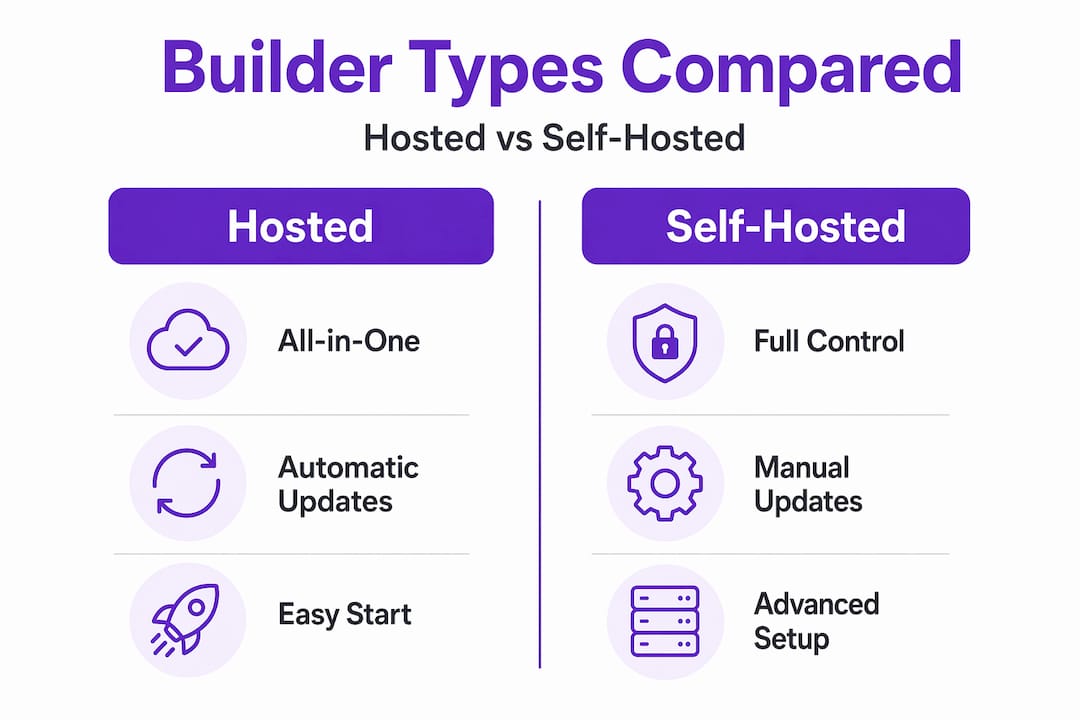
Self-hosted platforms give you more control but require more effort. You install the software on your own web hosting account and manage updates, backups, and security yourself. WordPress is the most well-known self-hosted option, and it powers WordPress hosting setups for millions of businesses worldwide. It’s powerful, but it does come with a steeper learning curve.
Here’s a quick comparison to help you decide:
| Feature | Hosted builder | Self-hosted (e.g. WordPress) |
|---|---|---|
| Ease of use | Very easy | Moderate to advanced |
| Monthly cost | $15 to $50 | $10 to $30 (hosting only) |
| Technical maintenance | Handled for you | You manage it |
| Customisation | Good | Excellent |
| Australian support | Often included | Varies by host |
| Setup time | Hours | Days to weeks |
For most Australian small business owners, hosted builders win on simplicity. You’re running a business, not a tech company. The time you’d spend managing a self-hosted setup is time taken away from serving your customers.
To identify which type suits you, ask yourself:
- Do I have any technical experience with websites or servers?
- How much time can I realistically dedicate to website maintenance each week?
- Do I need highly specific features or integrations that only a custom platform can provide?
- Is my budget fixed, or can I invest more for greater flexibility?
Statistic callout: Over 43% of all websites on the internet are built with WordPress, making it the world’s most popular content management system. But popularity doesn’t always mean the right fit for your situation.
Key features to look for in a website builder
With the main types in mind, let’s explore which features matter most for small business websites. Not all builders are created equal, and knowing what to look for will save you time and money.
Here are the features you should prioritise:
- Drag-and-drop editor: This is non-negotiable. A good editor lets you build and update pages visually without touching code.
- Mobile-responsive templates: More than half of all web traffic comes from mobile devices, so your site must look great on phones and tablets automatically.
- Built-in SEO tools: Search engine optimisation helps customers find you on Google. Look for builders that let you set page titles, descriptions, and image labels easily.
- E-commerce functionality: If you sell products or services online, you need a builder that supports shopping carts, payment gateways, and order management.
- Domain and email integration: Your website address and business email should connect seamlessly. Explore your website design options to see how design and domain services can work together.
- Reliable hosting: A slow or frequently offline website loses customers fast. Review web hosting considerations to understand what good hosting looks like and why it matters.
- Automatic backups: Things go wrong. A builder that automatically saves versions of your site means you can recover quickly without losing everything.
- SSL security certificate: This is the padlock icon in your browser’s address bar. It encrypts data and is now expected by customers and required by Google for good search rankings.
- Australian-based support: When something goes wrong at 9am on a Tuesday and you have a client meeting at noon, you need support that’s awake and local.
“The best website builder isn’t the one with the most features. It’s the one you’ll actually use consistently to keep your business looking professional online.”
Pro Tip: Always test a builder’s customer support before committing. Send a question via live chat or email during your free trial and see how quickly and helpfully they respond. This tells you everything about what your experience will be like when something goes wrong.
Practical steps to get started with a website builder
Knowing what’s needed is one thing. Here’s exactly how you can get your business online, step by step.
- Sign up for a free trial: Most reputable builders offer a free trial period. Use this to explore the interface before spending any money.
- Choose a template: Browse templates relevant to your industry. Pick one that feels close to what you want, because you’ll be customising it anyway.
- Add your content: Replace the placeholder text and images with your own. Include your business name, contact details, services, and a clear call to action on your homepage.
- Customise the design: Adjust colours, fonts, and layout to match your brand. Keep it consistent and clean rather than trying to use every feature available.
- Connect your domain name: Every professional website needs its own address. Choose a domain name that reflects your business name and is easy for customers to remember.
- Preview on mobile: Before publishing, check how your site looks on a smartphone. Fix anything that looks cramped or hard to read.
- Publish and promote: Once you’re happy, hit publish. Then share your new website address on your social media profiles, email signature, and business cards.
Here’s a realistic look at the time and cost involved at each stage:
| Stage | Time required | Estimated cost |
|---|---|---|
| Sign up and explore | 1 to 2 hours | Free (trial) |
| Choose and customise template | 3 to 8 hours | Included in plan |
| Write and add content | 2 to 5 hours | Your time only |
| Register domain name | 15 minutes | $15 to $30 per year |
| Connect domain and launch | 30 minutes | Included in plan |
| Ongoing monthly updates | 1 to 2 hours/month | Monthly plan fee |
For ongoing management, set aside a small amount of time each month to review your content, check that all links work, update your photos if needed, and respond to any enquiries coming through your contact form. A neglected website can actually hurt your credibility more than having no website at all.
Common questions and pitfalls for Australian businesses
Before you jump in, let’s cover some of the most common challenges and questions Australian small businesses face when getting started with a website builder.
The most frequent mistakes include:
- Ignoring mobile design: A site that looks great on a desktop but breaks on a phone will frustrate the majority of your visitors. Always test on multiple devices.
- Choosing a weak domain name: Avoid using numbers, hyphens, or obscure words in your domain. Keep it short, memorable, and clearly connected to your business name.
- Not linking to social media: Your website and social profiles should work together. Make it easy for visitors to find and follow you.
- Skipping the contact page: Customers who can’t easily find your phone number or email will simply move on to a competitor.
- Using low-quality images: Blurry or irrelevant photos make even a well-designed site look unprofessional. Use clear, high-quality images that represent your business honestly.
On the Australian-specific side, if you want a .com.au domain, you’ll need to demonstrate an Australian Business Number (ABN) or be a registered Australian business entity. This is a government requirement, not something the domain provider can waive. It’s worth setting up before you start your website build so you can secure your preferred address without delay.
Knowing when to get help versus doing it yourself is also important. If your website needs complex booking systems, custom databases, or intricate integrations with other software, that’s when professional support becomes genuinely worthwhile. For most small businesses, though, a well-configured builder handles everything needed. You can browse sample business sites to see what’s achievable with the right tools and a bit of effort.
Pro Tip: Register your domain name separately from your website builder if possible. This gives you full ownership and makes it easier to switch providers in the future without losing your web address.
Why the right website builder matters more than ever
Here’s an opinion you might not expect: the biggest mistake Australian small business owners make with website builders isn’t choosing the wrong one. It’s treating the decision as purely a cost comparison exercise.
Customers now expect every business, no matter how small, to have a credible online presence. If someone hears about your business and searches for you online only to find nothing, or worse, a half-finished site with placeholder text, they will question whether you’re still operating. A missing or poor website has become a trust-breaker in a way that simply wasn’t true ten years ago.
What most people overlook when choosing a builder is the question of ongoing support and scalability. You might start with a simple five-page site today, but in two years you might want to add online bookings, a blog, or an online shop. A builder that can’t grow with you will force you to start over, and that costs time, money, and momentum.
The other thing worth saying plainly: local support matters enormously. When you’re dealing with a technical issue and your website is down during business hours, speaking to someone who understands Australian business conditions, time zones, and even the nuances of .com.au domains is worth more than any discount on a monthly plan. Modern website builders have genuinely levelled the playing field for small enterprises. A sole trader with a well-built website can look just as credible as a company with fifty employees. That’s a remarkable opportunity, and it’s one that’s completely within reach for any Australian business owner willing to invest a few hours of their time.
Get started with the best website solutions
If you’re ready to put these lessons into action, getting the right support makes all the difference. Distribute Group works with Australian small businesses to make the process of getting online as smooth and stress-free as possible.
Whether you need expert website design that reflects your brand, reliable WordPress hosting solutions that keep your site fast and secure, or flexible web hosting plans that grow with your business, Distribute Group has you covered with genuinely local support. Our team understands the challenges Australian small businesses face and is here to help you build an online presence you’re proud of. Reach out today and let’s get your business the website it deserves.
Frequently asked questions
Can I build a website without any technical skills?
Yes, modern website builders are designed for complete beginners and require no coding or design experience whatsoever. If you can type and drag a file on your computer, you have all the skills needed.
How much does using a website builder cost in Australia?
Most website builders offer affordable monthly plans, often ranging from $15 to $35, which typically include hosting, templates, and customer support. Annual plans usually offer a discount compared to paying month by month.
Do I still need to buy a domain name?
Yes, you’ll need to register a domain name to give your website a professional address that customers can find and remember. Some builders include a free domain for the first year, but you’ll need to renew it annually.
What is the difference between website builders and WordPress?
Website builders usually bundle hosting, security, and support into one simple plan and are much easier for beginners to use straight away. WordPress offers greater flexibility and customisation but requires separate hosting and a willingness to manage more of the technical side yourself.
Is support available if I get stuck using a website builder?
Yes, most reputable providers offer live chat, email, or phone support to help you launch and maintain your site. Choosing a provider with Australian-based support means you’ll get help during your actual business hours, not in the middle of the night.
Leave a Reply