




Most people assume a domain name is just a free label you pick and keep forever. It’s not. Understanding why domain names cost money means understanding a surprisingly layered system of registries, registrars, branding value, and ongoing fees that don’t disappear after your first year. Whether you’re launching a business or buying your first personal website, the cost of domain names affects every decision you make from day one. This guide breaks down exactly where your money goes, why premium domains carry a very different price tag, and how to make smarter choices before you register anything.
Table of Contents
- Key takeaways
- Why domain names cost money: the fee structure explained
- Premium and aftermarket domains: why some cost far more
- Domain names as brand assets
- How to budget and choose wisely
- My honest take on domain costs
- Get started with transparent domain pricing
- FAQ
Key takeaways
| Point | Details |
|---|---|
| Fees go to multiple parties | Your registration fee covers registry wholesale costs, registrar markups, and a mandatory ICANN charge. |
| Renewal costs are the real story | First-year pricing is often discounted; what you pay to renew annually is what actually matters. |
| Premium domains carry ongoing costs | Registry-designated premium domains attract higher renewal fees every year, not just at registration. |
| Domain names are brand assets | A strong domain builds trust, aids recall, and can reduce marketing costs over the long term. |
| Compare before you register | Always check renewal pricing, not just the promotional first-year rate, before committing to a domain. |
Why domain names cost money: the fee structure explained
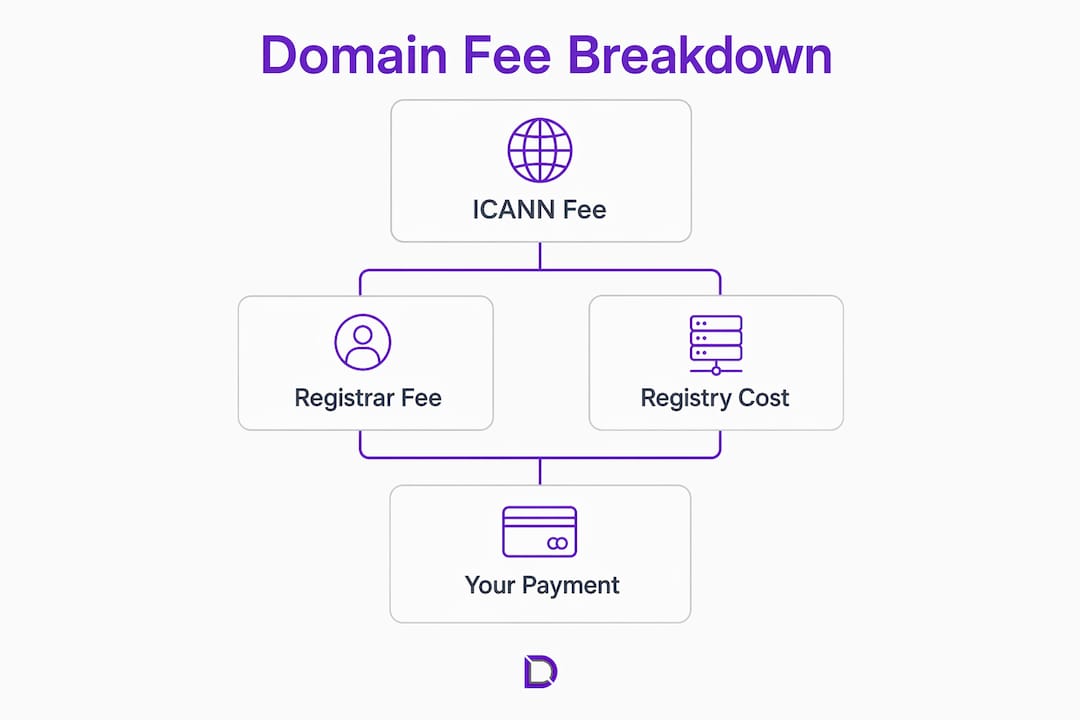
When you register a domain, your payment doesn’t go to a single entity. It flows through a structured system with three distinct layers, each of which adds to what you ultimately pay.
At the top sits the registry. Registries are the organisations responsible for managing specific top-level domains (TLDs). Verisign, for example, manages .com. They set wholesale prices that every accredited registrar must pay. As of November 2026, Verisign raised its wholesale fee for .com domains to $10.97 per year, with contracts allowing up to 7% annual increases going forward. That wholesale cost is baked into every .com you register.
Below the registry sits the registrar, the company you actually buy from. Registrars pay the registry wholesale fee and then apply their own margin on top. This is why prices for the same .com domain can vary from one provider to another. Some registrars keep margins thin and compete on price; others bundle extras like privacy protection or email hosting into a higher-priced package.
Then there’s the ICANN fee. ICANN, the global authority overseeing domain name coordination, charges a mandatory $0.20 fee per transaction. This applies to every registration, renewal, and transfer. It’s either listed separately at checkout or rolled into the final price, but it’s always there.
What standard pricing actually looks like
Standard domain names typically cost between $10 and $20 annually, covering administrative and registry maintenance costs. Renewal fees generally land between $15 and $25 per year depending on the registrar and TLD. Here’s a rough guide to common TLD pricing:
| TLD | Typical first-year price | Typical renewal price |
|---|---|---|
| .com | $10 to $18 | $15 to $25 |
| .com.au | $20 to $30 | $20 to $35 |
| .net | $12 to $20 | $15 to $25 |
| .org | $10 to $18 | $15 to $22 |
| New gTLDs (.store, .tech) | $2 to $15 | $25 to $60+ |
One pattern worth noting: new generic TLDs often have very low first-year promotional pricing but significantly higher renewal fees. Domain registries can raise wholesale prices with just 180 days’ notice, which means the renewal cost you face in year two or three may look nothing like what you paid to get started.
The factors affecting domain prices at the standard level come down to the TLD you choose, the registrar’s margin, and whether you’re in a promotional window. Those three variables explain most of the variation you’ll see when shopping around.
Premium and aftermarket domains: why some cost far more
Not all domains are priced equally. Some carry what’s known as a registry-level premium, meaning the registry itself has flagged the domain as high value and assigned it a higher price tier. This is separate from the standard registration process entirely.

Premium domains are typically short, contain common dictionary words, or include high-traffic keywords. Think single words, three-letter combinations, or terms with obvious commercial value. These names are premium domains by registry designation, and their elevated renewal fees apply every year for the life of the domain.
This is where many buyers get caught out. Premium domain renewals can range from $100 to several thousands of dollars per year, based on how desirable the registry considers the name. Registering a premium domain at $300 in year one means paying $300 again in year two, and the year after that, indefinitely.
Then there’s the aftermarket, which is a different situation again. Aftermarket domains are names that have already been registered by someone else and are being sold for a profit. The seller, not the registry, sets the price. Recent high-profile examples include AI.com selling for $70 million and Commerce.com changing hands for approximately $2.2 million. These prices reflect market demand and perceived business value, not registry fees.
| Domain type | Who sets the price | Renewal cost | Key risk |
|---|---|---|---|
| Standard | Registry + registrar | $15 to $25/year | Promotional vs renewal gap |
| Registry premium | Registry | $100 to $5,000+/year | Ongoing annual cost |
| Aftermarket | Seller | Standard or premium rate | High upfront cost |
Pro Tip: Before registering any domain, especially a new gTLD or one with a suspiciously low first-year price, search for the renewal cost specifically. One registrar advertised a domain at $4.99 for the first year with an annual renewal of $750. That’s not a deal. That’s a trap.
Understanding what influences domain pricing at the premium level comes down to three factors: the length of the name, the commercial value of the words it contains, and whether it’s been designated premium by the registry or is being sold by a third-party owner. All three drive prices in different directions.
Domain names as brand assets
There’s a reason well-funded businesses pay significant sums for a great domain. A domain name isn’t just a technical address. It’s often the first thing a potential customer sees, and it shapes how they perceive your brand before they’ve read a single word on your website.
Short, memorable domains improve marketing effectiveness and reduce customer acquisition costs. A domain that’s easy to spell, easy to say aloud, and clearly connected to your brand means less friction between someone hearing about your business and actually finding you online. The opposite is also true. A clunky domain with hyphens, numbers, or an obscure extension creates doubt and confusion.
“A domain name is either a brand asset or digital noise. There’s no middle ground.”
This framing matters because it reframes the question from “why are domains expensive?” to “what is the return on this investment?” When you weigh up whether a domain is worth it, consider what you’re actually paying for:
- Credibility in your industry and with customers
- A memorable address that works in verbal conversations, on business cards, and in advertising
- Protection of your brand against competitors registering similar names
- A long-term asset that appreciates in value as your brand grows
A business running on a mismatched or forgettable domain loses traffic every day through confusion and low recall. That’s a real ongoing cost, even if it doesn’t show up on an invoice. Treating your domain registration fees as a branding investment, rather than a technical expense, changes how you approach the decision entirely.
For businesses building a professional online presence, checking out domain registration options with transparent renewal pricing is a smart starting point.
How to budget and choose wisely
Knowing the cost structure is one thing. Applying it to a real decision is another. Here’s a practical framework for approaching domain name selection and budgeting.
- Search for renewal pricing, not just first-year pricing. Many registrars display the promotional rate prominently and bury the renewal rate. Find it before you register.
- Compare at least two or three registrars. Prices for the same domain vary. Five minutes of comparison can save you $10 to $15 per year, which adds up across multiple domains over time.
- Match the extension to your audience. Australian businesses benefit from .com.au because it signals local credibility. International businesses often do better with .com. The extension matters for trust and discoverability.
- Avoid paying a premium for novelty extensions. New gTLDs like .store or .tech can work well, but check their renewal costs carefully. Some carry inflated fees that aren’t justified by the brand benefit they deliver.
- Assess whether a premium domain is worth the ongoing cost. If the name is central to your brand strategy and highly memorable, paying more may be justified. If it’s a nice-to-have, a quality standard domain will serve you just as well.
Pro Tip: Register your primary domain for multiple years upfront if your budget allows. This locks in the current renewal rate and protects you from price increases. Registries can raise wholesale prices with relatively short notice, so multi-year registration offers real financial protection.
The question of whether a domain name is worth it depends entirely on how well it aligns with your brand, your audience, and your long-term goals. A $15 domain that perfectly represents your business is worth far more than a $3,000 premium domain you bought on impulse.
For ongoing cost management and renewal oversight, domain management services can help businesses stay on top of multiple domains without surprises.
My honest take on domain costs
I’ve worked with dozens of businesses at the point where they’re trying to figure out whether a particular domain is worth the price. And what I keep seeing is the same mistake repeated: people fixate on the registration cost and ignore the renewal cost. Every single time.
In my experience, the renewal trap is more damaging than paying a high upfront price for a premium domain. At least with a premium purchase, you know what you’re signing up for. With a $2.99 first-year special that renews at $45, you’ve made a commitment without realising it. By the time the renewal invoice arrives, the brand is built around that domain and switching feels too risky.
The other misconception I see constantly is treating domain registration fees as an unavoidable tax rather than a deliberate investment. The businesses that do well online are the ones that chose a domain name with the same care they gave their business name. They thought about how it sounds, how it looks on a sign, and what it says about them before they spent a cent.
My advice is straightforward: spend 30 minutes researching domain options before you register anything. Check renewal costs. Compare registrars. Think about the extension from your customer’s perspective, not just your own. The cost of getting it right the first time is almost always lower than the cost of switching later.
— James
Get started with transparent domain pricing
Understanding domain costs is the first step. Finding a provider who’s upfront about them is the second.
Com offers Australian businesses clear, honest pricing on domain registrations and renewals, with no surprise fees buried in the fine print. Whether you’re registering your first domain or managing a portfolio of names for a growing brand, the team at Com provides personalised local support to help you make the right call. Explore domain management services that include transparent renewal policies, or browse available domain names to find the right fit for your business. Getting the domain right from the start is one of the smartest moves you can make for your brand online.
FAQ
Why do domain names have annual fees?
Domain names require ongoing fees because registries and registrars have real operational costs, including server maintenance, security, and compliance. ICANN charges a mandatory $0.20 per transaction, and registry wholesale fees are applied every year at renewal.
Why are some domains so expensive compared to others?
Premium domains carry higher prices because they contain high-value keywords, are short, or have been designated as premium by the registry. Premium renewals can reach thousands of dollars per year based on demand and desirability.
Is a domain name worth the ongoing cost?
For most businesses, yes. A strong domain builds credibility and reduces customer acquisition costs, making it a brand asset rather than a simple technical expense.
What is the average cost of a domain name per year?
Standard domains typically cost between $10 and $20 to register annually, with renewals generally between $15 and $25 depending on the TLD and registrar.
How can I avoid paying too much for a domain?
Always check the renewal price before registering, compare multiple registrars, and be cautious of low first-year promotional rates on new gTLDs. Promotional first-year pricing is often followed by significantly higher renewal fees.
Leave a Reply