




Domain renewal is the process of extending your domain name registration before it expires, so your website and email services stay active without interruption. Every domain name has an expiry date, and missing it puts your entire online presence at risk. For individuals and small business owners, understanding the domain renewal process is not optional. It is the single most important maintenance task tied to your online address. This article explains what domain renewal involves, how the timeline works, what happens when you miss a deadline, and how to manage renewals without stress.
What does domain renewal mean and how does it work?
Domain renewal means paying your registrar to extend your ownership of a domain name for another registration period. Think of it like renewing a lease. You do not own the domain outright. You hold a licence to use it, and that licence has an end date.
Domain registrations commonly last one year and must be renewed annually, though multi-year options are available. That annual cycle is the industry standard set by ICANN, the global body that oversees domain name policy. Your registrar, the company you registered the domain through, handles the renewal transaction on your behalf.
The importance of domain renewal goes beyond just keeping a web address. Your website, business email, and any services tied to that domain all depend on it staying active. A lapsed domain takes everything offline at once.

Pro Tip: Register your domain for two or more years upfront. It reduces the number of renewal cycles you need to manage and locks in your current pricing.
What is the standard domain renewal timeline?
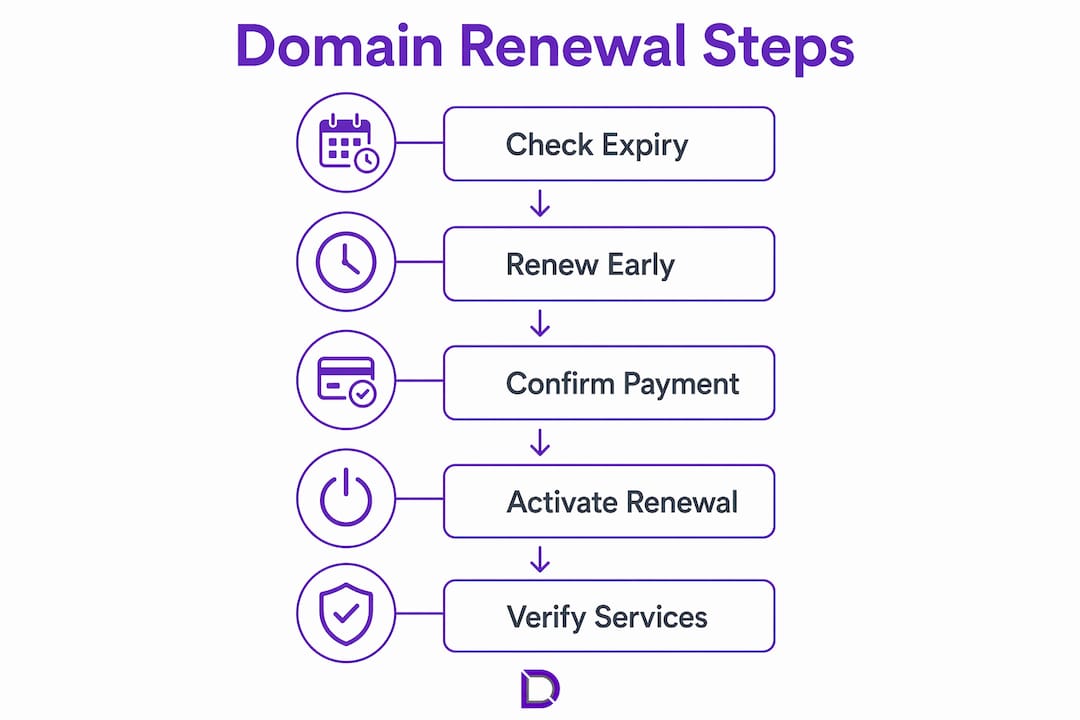
The domain renewal process follows a predictable sequence, and knowing it gives you time to act before anything goes wrong.
- Registration period begins. You register a domain for one year or more. The clock starts from the registration date.
- Renewal reminders start. Registrars send expiration notifications starting months in advance, with follow-up emails weekly and then daily as the date approaches.
- Renewal window. You can renew at any point before expiry at the standard price. Most registrars allow renewal up to 90 days before the expiry date.
- Expiry date. If no renewal is processed, the domain expires. Services tied to it stop working immediately.
- Grace period. Most domains enter a grace period of around 30 days after expiry. Renewal during this window costs the standard price with no penalty.
- Redemption period. After the grace period, the domain moves into redemption. This phase lasts 30–35 days and recovery involves significant fees imposed by the registry.
- Pending delete. After redemption, the domain enters a pending delete phase lasting 5–7 days. Once this ends, the domain is released back to the public for anyone to register.
Pro Tip: Do not rely solely on registrar reminder emails. Add your domain expiry date as a recurring calendar event so you have a backup alert that is independent of your inbox.
Understanding types of domain registration options helps you choose the right registration length from the start, which directly reduces renewal risk.
What happens if you miss your domain renewal deadline?
Missing a domain renewal deadline triggers a chain of events that gets more expensive and more difficult to reverse the longer you wait.
The immediate consequences include:
- Website goes offline. Visitors see an error page or a registrar parking page instead of your site.
- Email stops working. All email addresses tied to the domain stop receiving and sending messages. Domain expiry affects email in ways that can take days to recover from even after renewal.
- Business credibility takes a hit. Clients who cannot reach your website or email during an outage often assume the business has closed.
The grace period is your first safety net. Most domains allow renewal at the standard price for around 30 days after expiry. Act within this window and you avoid any extra costs.
After the grace period, the domain enters redemption. Redemption fees range from $60 to over $250 and are set by the registry, not your registrar. These are not service markups. They are external charges that registrars pass on directly.
The redemption phase is effectively a “lost property” status for your domain. The registry holds it for you, but the cost to reclaim it reflects the administrative burden of that process. Waiting until this stage can cost more than a year’s worth of renewals in a single transaction.
Once the domain moves into pending delete, recovery becomes impossible. After 5–7 days in that phase, the domain is released publicly and anyone can register it. Competitors, domain squatters, or automated bots can claim it within seconds of release.
How does auto-renewal work and why does it matter?
Auto-renewal is the automatic extension of your domain registration through automatic billing, triggered before the expiry date. It is the most reliable way to prevent accidental domain expiry.
Auto-renew is enabled by default at many registrars but can be turned off by the account holder. When active, the registrar charges your saved payment method and extends the registration without any action required from you. That hands-off process is its biggest advantage for busy small business owners.
The benefits of auto-renewal include:
- No manual tracking required. The renewal happens automatically as long as your payment details are current.
- No grace period risk. You never enter the post-expiry window because the renewal processes before the expiry date.
- Consistent pricing. You pay the standard renewal rate rather than redemption fees.
The risks are worth knowing too. Auto-renew can lead to unexpected charges if you have forgotten about a domain or if your payment method has changed. A failed auto-renewal attempt due to an expired credit card can leave you exposed without any warning.
Managing auto-renewal well means checking your registrar account at least twice a year. Confirm your payment method is current, your billing email is active, and auto-renew is switched on for every domain you want to keep.
Pro Tip: Set a calendar reminder every six months to log into your registrar account and verify your payment details and auto-renew settings. One check can prevent a very costly mistake.
Understanding how a domain registrar works gives you a clearer picture of where auto-renewal sits in the broader registration process and what your registrar is responsible for.
How to manage domain renewal effectively as a small business
Proactive domain management is the difference between a business that stays online and one that goes dark without warning. These steps give you a reliable system.
- Keep your contact details current. Your registrar sends renewal reminders to the email address on your account. An outdated email means you miss every notification. Log in and check your contact details at least once a year.
- Update your billing information promptly. A new credit card or bank account needs to be updated in your registrar account before auto-renewal attempts to process. Do not wait until the renewal date.
- Enable auto-renewal as a baseline. Auto-renewal is your primary safety net. Manual renewal is a backup, not the other way around.
- Set independent reminders. Add your domain expiry date to your calendar with alerts at 90 days, 30 days, and 7 days before expiry. These sit outside your email inbox and cannot be missed.
- Consider multi-year registration. Renewing for multiple years protects against future price increases and reduces the number of renewal cycles you need to manage. Domains can be registered for up to 10 years in advance.
- Use a reputable registrar with clear policies. Choose a registrar that communicates renewal timelines clearly, offers auto-renewal, and has accessible customer support. Australian businesses benefit from working with a registrar that understands local requirements and can provide direct assistance.
- Review renewal pricing annually. Renewal prices can differ from registration prices. Check what you will be charged before the renewal date so there are no surprises.
Domain management also connects directly to your web hosting and email services. A lapsed domain takes all three offline simultaneously. Treating domain renewal as part of a broader digital maintenance routine, rather than a one-off task, keeps everything running together.
Key takeaways
Domain renewal is the single most time-sensitive maintenance task for any business with an online presence. Missing the deadline costs far more than the renewal itself.
| Point | Details |
|---|---|
| Domain renewal defined | Renewal extends your domain licence for another period, keeping your website and email active. |
| Standard timeline | Registrars send reminders from 30 days out; a grace period of around 30 days follows expiry. |
| Redemption fees are steep | Recovery after the grace period costs $60 to over $250, set by the registry, not your registrar. |
| Auto-renewal is your safety net | Enable it and keep payment details current to avoid accidental expiry and service outages. |
| Multi-year registration reduces risk | Registering for multiple years cuts renewal cycles and can lock in current pricing. |
Why I think most small businesses underestimate domain renewal risk
Most small business owners treat domain renewal as an afterthought. They set it up once, assume the registrar will handle everything, and move on. That assumption is where things go wrong.
I have seen businesses lose domains they had held for years because a credit card expired and auto-renewal failed silently. By the time anyone noticed, the domain was in redemption and the recovery cost was more than three times the annual renewal fee. The business email was down for four days. Clients assumed the worst.
The part that surprises most people is the redemption fee structure. Those fees are not a registrar penalty. They are set by the registry, the body that controls the top-level domain like .com.au or .com. Your registrar has no control over them and no ability to waive them. Once you are in redemption, you pay what the registry charges.
My honest recommendation is to treat your domain like a utility bill. Enable auto-renewal, keep your payment details current, and set a calendar reminder twice a year to check your account. That is a 10-minute task that protects everything your business has built online.
Small businesses often invest significantly in websites, branding, and digital marketing. All of that sits on top of a domain name that costs less than a tank of petrol per year to maintain. The risk-to-cost ratio makes domain renewal one of the most straightforward protections available.
— James
Domain management made simple with Com
Keeping your domain renewed and your online presence intact does not need to be complicated. Com provides Australian individuals and small businesses with domain management services built around local support and clear renewal processes.
Com handles renewal reminders, multi-year registration options, and auto-renewal settings so you are never caught off guard. Whether you are registering a new domain or taking control of an existing one, the team at Com offers the kind of personalised guidance that generic platforms do not. Explore domain registration options and find the right setup for your business today.
FAQ
What does domain renewal mean in simple terms?
Domain renewal means paying your registrar to extend your right to use a domain name for another period, typically one year. Without renewal, the domain expires and your website and email stop working.
What does auto-renewal domain mean?
Auto-renewal means your registrar automatically charges your saved payment method and extends your domain registration before it expires. It prevents accidental expiry as long as your billing details are current.
How long is the grace period after a domain expires?
Most domains have a grace period of around 30 days after expiry where renewal is available at the standard price. After that, the domain enters a redemption phase with fees ranging from $60 to over $250.
What is domain expiry and what happens during pending delete?
Domain expiry is when your registration period ends and services tied to the domain stop working. After the grace and redemption phases, the domain enters pending delete for 5–7 days before being released publicly for anyone to register.
How far in advance can I renew my domain?
Most registrars allow renewal up to 90 days before the expiry date at the standard price. Domains can also be registered for up to 10 years in advance, reducing the frequency of renewal cycles.
Leave a Reply