


A business portfolio website is a dedicated online platform that showcases your work, services, and achievements to attract clients and build credibility. Unlike a social media profile or a PDF sent by email, it gives you full ownership of your professional presence. You control the design, the content, and the story you tell. For small business owners and individual professionals, understanding what is a business portfolio website is the first step to competing seriously online.
What is a business portfolio website and what does it include?
A business portfolio website is a purpose-built site that presents your best work in a structured, professional format. It differs from a general business website because the focus is on demonstrating capability through real projects, outcomes, and client results. Think of it as your most persuasive sales document, available online around the clock.
Effective portfolio sites include at least five core components: a homepage, a projects showcase, an about page, contact details, and client testimonials. Each element serves a specific purpose in moving a visitor from curious to convinced.

The standard industry term for this type of site is a “professional portfolio website,” though the format applies equally to sole traders, consultants, photographers, trades businesses, and agencies. The key distinction is intentionality. Every page exists to answer one question: “Why should I hire this person or business?”
What essential components make an effective portfolio site?
A strong portfolio site is built around pages that answer visitor questions before they think to ask them.
- Homepage: Introduces your business clearly and includes a direct call to action. A homepage should briefly state what you do and guide visitors to the next step, whether that is viewing your work or making contact.
- Projects showcase: Displays your best work with context. Each project entry should describe the goal, your role, and the measurable outcome. Vague descriptions lose clients. Specific results win them.
- About page: Tells your story in a way that builds trust. Clients hire people, not just services. A well-written about page closes the gap between a stranger and a trusted provider.
- Contact page: Makes it easy to reach you. A contact form, phone number, email address, and location (where relevant) all reduce friction for potential clients.
- Testimonials: Provide social proof that your work delivers results. Written quotes, star ratings, or case study summaries all work. Place them near calls to action for maximum effect.
Beyond content, technical performance matters. Visitors form an opinion about a website in 50 milliseconds. That means slow load times or a broken mobile layout can cost you a client before they read a single word.
Pro Tip: Keep images under 500KB to improve load speed and mobile performance. A compressed image looks identical to the viewer but loads far faster, which directly affects whether visitors stay or leave.
What are the key benefits of a business portfolio website?
A portfolio website acts as your hardest-working employee, operating 24/7 as both a brand ambassador and a salesperson. It never takes a day off, never misses a lead, and never forgets to mention your best project.
The benefits go well beyond visibility:
- Credibility on demand: A professional design with clear project descriptions builds client confidence before a single conversation takes place.
- Client discoverability: Potential clients can find and evaluate your work through search engines, which a PDF portfolio or Instagram profile cannot match.
- Narrative control: You decide what story your business tells. Social platforms change their algorithms and display rules constantly. Your own site does not.
- SEO and long-term reach: A well-structured portfolio site with relevant content can rank in search results, bringing in leads you never had to chase.
A professional portfolio website can increase interview requests and client inquiries by up to 50%. That figure reflects a simple truth: when clients can see your work clearly and contact you easily, they do.
Owning your domain and hosting is the foundation of that control. Social platforms can change their rules, restrict your reach, or disappear entirely. Your own site stays exactly where you put it.
How to create a business portfolio website step by step
Building a portfolio site is a structured process. Rushing the technical setup before gathering quality content is the most common mistake. Allocate roughly 70% of your time to collecting and curating high-quality assets, and 30% to the technical build. That ratio produces far better results than the reverse.
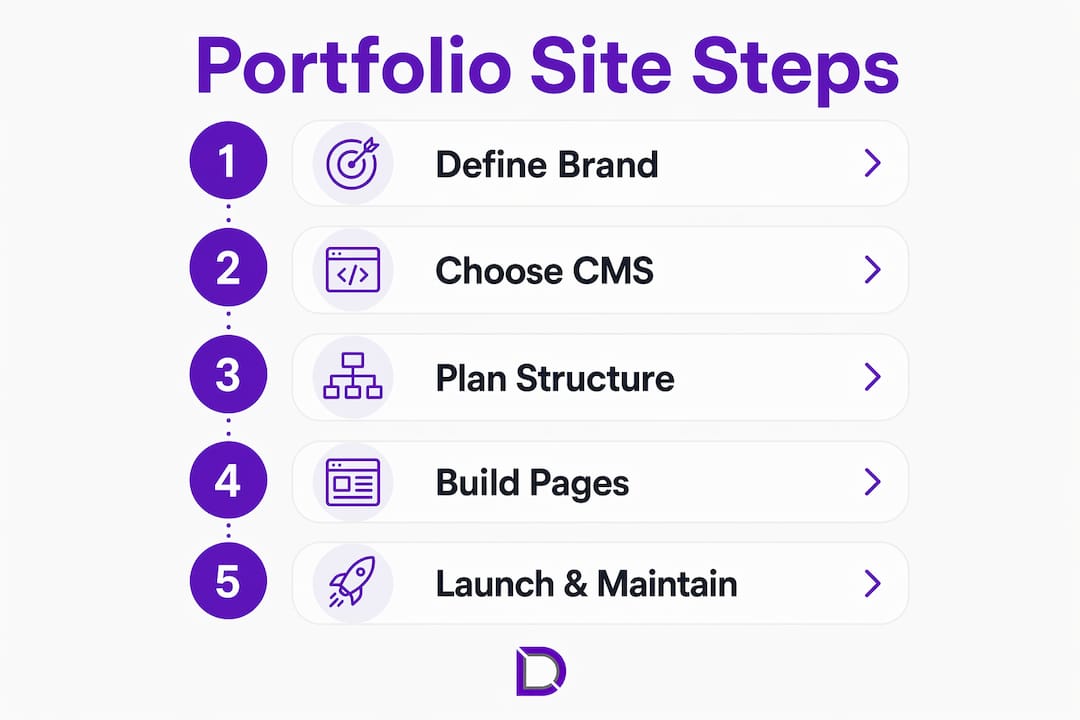
Step 1: Define your brand identity and choose a domain name
Decide how you want to be perceived before you build anything. Your domain name should reflect your business name or your core service. A clear, memorable domain builds trust from the first click. Com offers domain registration options suited to Australian businesses of every size.
Step 2: Choose a website builder or CMS
Website builders typically cost between $0 and $30 per month depending on the platform and feature tier. Entry-level drag-and-drop builders suit most sole traders and small businesses. More complex content management systems suit businesses that publish regular content or need custom functionality.
Step 3: Plan your site structure
Map out your pages before you start building. A standard portfolio site needs five to six pages: home, portfolio or projects, about, services (optional), contact, and testimonials. A clear structure prevents the common problem of a site that looks busy but communicates nothing.
Step 4: Build your key pages and add projects
Write project descriptions that follow the goal, role, and outcome format. Avoid vague language like “helped a client improve their business.” Instead, write: “Redesigned a retail client’s checkout process, reducing cart abandonment by a measurable margin.” Specificity is what separates a portfolio that wins clients from one that gets ignored.
Missing calls to action on project pages is one of the most costly errors a portfolio owner can make. Every project page should end with a direct prompt: “Interested in a similar result? Get in touch.”
| Step | Action | Time allocation |
|---|---|---|
| Brand and domain | Define identity, register domain | 1–2 days |
| Platform selection | Choose builder or CMS | Half a day |
| Content gathering | Collect projects, photos, testimonials | 70% of total build time |
| Technical setup | Build pages, configure settings | 30% of total build time |
| Launch and maintain | Publish, update monthly | 30 minutes per month |
Step 5: Launch and maintain regularly
A portfolio site is not a set-and-forget asset. Setting aside 30 minutes monthly to update your site keeps it relevant and signals to search engines that the site is active. Add new projects, refresh testimonials, and check that all contact forms still work.
Pro Tip: Automation tools can pull in fresh content such as published articles or reports directly to your site. This is particularly useful for consultants and strategists who produce regular written work and want their portfolio to reflect current expertise without manual effort.
Examples of effective business portfolio websites
The best portfolio sites share a few consistent traits regardless of industry. They are clear, fast, and focused on outcomes rather than process.
A graphic designer’s portfolio typically leads with a striking visual grid of completed projects. Each project links to a dedicated page with a brief on the client’s goal, the designer’s approach, and the final result. The best examples show only five to eight projects rather than every piece ever created. Showing only your best five projects demonstrates genuine expertise far more effectively than a gallery of thirty average ones.
A consulting firm’s portfolio takes a different form. It leads with a clear statement of the problem the firm solves, followed by case studies structured around measurable client outcomes. Testimonials from named clients with job titles carry significant weight in this category.
A trades business, such as a builder or electrician, benefits from a portfolio that combines before-and-after photography with brief project descriptions and suburb-level location details. This format supports local SEO and gives residential clients the visual reassurance they need before making contact.
Across all three examples, the common themes are clear calls to action, professional photography or imagery, and a contact method visible on every page. The professional website design choices that work best are rarely flashy. They are simply clear.
Key takeaways
A business portfolio website is the most controllable and cost-effective way for small business owners and professionals to showcase their work, build credibility, and attract clients online.
| Point | Details |
|---|---|
| Core definition | A portfolio site showcases your best work, services, and outcomes in one owned, professional platform. |
| Five essential pages | Every effective portfolio includes a homepage, projects showcase, about page, contact page, and testimonials. |
| Content before code | Allocate 70% of build time to gathering quality content and 30% to technical setup for the best results. |
| CTAs convert visitors | Every project page needs a direct call to action to turn interest into client inquiries. |
| Maintain monthly | Spending 30 minutes per month updating your site keeps it relevant and supports search engine visibility. |
Why most portfolio sites fail before they launch
The biggest mistake I see is treating a portfolio website as a technical project rather than a content project. Business owners spend weeks choosing a platform, debating colour schemes, and tweaking fonts. Then they launch with three placeholder projects and a contact form that goes nowhere.
The sites that actually win clients are built the other way around. The owner spends time gathering real project descriptions, collecting testimonials, and writing an about page that sounds like a human being rather than a corporate brochure. The technical side takes a fraction of that time once the content is ready.
The second mistake is ignoring mobile. A portfolio that looks polished on a desktop but breaks on a phone loses the majority of its audience before they reach the first project. Test every page on your phone before you publish.
The third mistake is the “set and forget” mentality. A portfolio with projects from three years ago signals to potential clients that the business may not be active. A quick monthly update, even just adding one new testimonial or refreshing a project description, keeps the site feeling current and the owner looking engaged.
The one thing I would tell every small business owner: your portfolio site is not a brochure. It is a conversation starter. Write it that way.
— James
Build your portfolio site on a solid foundation with Com
Getting your portfolio site right starts with the basics: a professional domain name and reliable hosting. Without these, even the best-designed site can feel untrustworthy to potential clients.
Com provides Australian businesses with domain registration and web hosting backed by personalised local support. Whether you are registering your first domain or moving an existing site to a more reliable host, Com makes the process straightforward. The team understands what Australian small businesses need and is available to help when questions come up. Start with a domain that reflects your business and hosting that keeps your portfolio online and fast.
FAQ
What is a business portfolio website?
A business portfolio website is a dedicated online platform that showcases your work, services, and client results to attract new business. It differs from a general business website by focusing specifically on demonstrating capability through real projects and outcomes.
How many projects should I include on my portfolio site?
Showing your best five projects produces stronger results than displaying a large number of average ones. Quality and specificity in each project description matter far more than volume.
How much does it cost to build a portfolio website?
Website builders typically cost between $0 and $30 per month, with additional costs for a domain name and hosting. The total investment depends on the platform you choose and whether you build it yourself or hire a professional.
How often should I update my business portfolio website?
Setting aside 30 minutes per month to add new projects, refresh testimonials, and check contact forms keeps your site current and supports search engine visibility.
Do I need my own domain for a portfolio website?
Owning your domain is the foundation of a professional portfolio. It gives you full control over your online presence and protects you from platform changes that could affect a hosted subdomain or social media profile.
Leave a Reply