




A professional website is a results-driven online platform that combines clear communication, user-centred design, and technical performance to represent a business credibly and convert visitors into customers. For Australian business owners, it is far more than a digital brochure. It is your brand headquarters, your lead generator, and often the first point of contact a potential customer has with your business. Visitors form an opinion in under 0.05 seconds, which means your site must communicate value immediately. WordPress alone powers 43% of the web, yet platform choice is only one piece of what makes a site truly professional.
What is a professional website and what sets it apart?
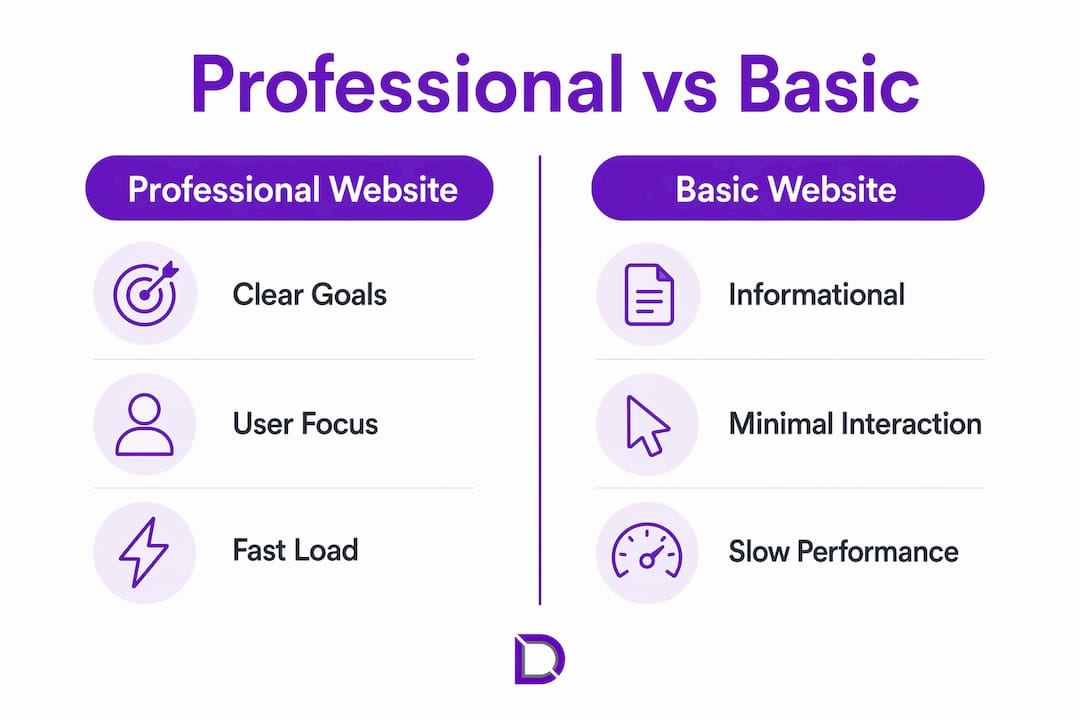
A professional website is defined by its ability to serve clear business goals through usability, search engine optimisation, and conversion-focused design. The difference between a basic site and a professional one is not cosmetic. It is structural, strategic, and measurable.
Basic sites often exist simply to confirm a business is real. Professional sites are built to do work: attract the right visitors, build trust quickly, and guide those visitors toward a specific action. That action might be a phone call, a quote request, or a purchase. Every element on the page should serve that purpose.

The term used across the web industry is “professional web design,” and it describes a discipline that balances aesthetics with performance. A site can look polished and still fail if it loads slowly, breaks on mobile, or buries its contact details. Equally, a technically sound site with confusing copy will lose visitors before they convert.
Australian business owners often underestimate how much their website communicates before a single word is read. Font choices, image quality, white space, and colour consistency all signal whether a business is credible or not.
What features distinguish a professional website from a basic site?
Professional websites share a consistent set of features that basic sites typically lack. These features work together to create trust, guide visitors, and support business growth.
- Clear value proposition. Your homepage must answer “what do you do and who do you do it for” within the first few seconds. Visitors who cannot identify your offer immediately will leave.
- Consistent branding. Colours, fonts, image styles, and tone of voice must match across every page. Visual consistency and error-free details build trust and credibility directly.
- Mobile responsiveness. A site that breaks on a smartphone is not professional by any current standard. Mobile traffic accounts for the majority of web visits in Australia.
- High-quality photography. Stock photos signal inauthenticity. Real photography of your team, premises, or products builds connection and trust far more effectively.
- Effective calls to action. Every page needs a clear next step. “Get a quote,” “Book a call,” or “Download the guide” are specific and direct. “Click here” is not.
- SEO-optimised content. Professional sites are built with search intent in mind. Pages target specific queries, use structured headings, and provide genuine value to the reader.
- Accessibility and load speed. Sites must comply with WCAG accessibility standards and load fast enough to retain impatient visitors.
The design philosophy behind all of this is captured well by the principle of clarity before cleverness. Animated intros, complex layouts, and trendy visual effects rarely improve results. They usually get in the way.
Pro Tip: Before redesigning your site, audit your current calls to action. If you cannot identify one clear next step on each page, that is the first thing to fix.
What technical standards define a professional website?
Technical performance is the foundation that design sits on. A beautiful site that loads slowly or gets hacked is not professional. It is a liability.
Speed and performance benchmarks
Page speed directly affects both user experience and search rankings. The industry benchmark for Time to First Byte (TTFB) is under 109 milliseconds. TTFB measures how quickly a server responds to a browser request. A slow TTFB signals poor hosting, unoptimised code, or both. Choosing the right hosting plan for your site is one of the most direct ways to improve this metric.
Security and maintenance
- Software updates. Content management systems, plugins, and themes must be updated regularly. Outdated software is the most common entry point for attacks.
- Security patching. Vulnerabilities are discovered constantly. Patching them promptly is non-negotiable for any business handling customer data.
- Automated backups. Daily backups stored off-site protect against data loss from attacks, server failures, or accidental deletions.
- Spam monitoring. Contact forms and comment sections attract bot traffic. Filtering this protects your server resources and your inbox.
- Performance monitoring. Regular checks on uptime, speed, and error rates catch problems before visitors do.
Ongoing maintenance is critical and often neglected by business owners who treat their site as a one-time project. A professional website is an ongoing service, not a finished product.
Accessibility compliance
Professional sites must meet a minimum of 180 WCAG accessibility rules. These rules cover things like colour contrast ratios, keyboard navigation, and alt text for images. Accessibility compliance is both an ethical obligation and a legal consideration in Australia under the Disability Discrimination Act 1992.
Ownership and vendor independence
| Asset | What you must own | Risk if you don’t |
|---|---|---|
| Domain name | Registered in your name | Losing access if provider closes |
| Hosting account | Admin credentials in your control | No ability to migrate or recover |
| CMS access | Full admin login | Cannot update or export your content |
| Source code | Portable, standard code | Locked into one provider forever |
Ownership of your domain, hosting, and CMS is non-negotiable. Businesses that allow agencies or developers to register assets in their own names risk losing everything if the relationship ends. Avoiding proprietary or “trap custom code” is equally important for long-term flexibility.
Pro Tip: Ask any web developer or agency to confirm in writing that all domain, hosting, and CMS credentials will be registered in your business name before work begins.
How does a professional website benefit Australian businesses?
The business case for a professional website is direct and measurable. The benefits extend well beyond aesthetics.
- Stronger first impressions. With opinions forming in under 0.05 seconds, a polished, fast-loading site signals credibility before a visitor reads a single word.
- Higher trust and authority. A consistent, error-free site with real photography and clear messaging positions your business as established and reliable.
- Better conversion rates. Strategic design with SEO and conversion paths turns passive visitors into active leads. A well-placed call to action on a high-traffic page can meaningfully increase enquiries.
- Organic search traffic. SEO-optimised architecture means your site appears in search results when potential customers are actively looking for what you offer. This is free, compounding traffic.
- Support for sales and customer service. FAQ pages, product information, booking systems, and contact forms reduce the time your team spends answering repetitive questions.
- Competitive advantage. Many Australian small businesses still operate with outdated or poorly designed sites. A professional site immediately differentiates you from competitors who have not invested in theirs.
The combination of form and function is what separates sites that generate business from sites that simply exist. A professional site works for you around the clock, in every time zone, without additional staffing costs.
How to build or upgrade a professional website effectively
Building a professional website is a project that rewards planning. Rushing into design before strategy is the most common and costly mistake.
- Define your business goals first. What do you want the site to do? Generate leads, sell products, book appointments, or build brand awareness? Your goals determine every design and content decision that follows.
- Identify your audience. Who are you trying to reach? What do they need to know before they trust you? What language do they use when searching for your services?
- Plan your site architecture. Map out your pages before any design work begins. A clear structure, typically home, services, about, and contact, makes navigation intuitive and supports SEO.
- Choose your platform and hosting. WordPress is the most widely used platform and costs $40 to $800 USD annually for hosting and infrastructure depending on your needs. Review the differences between free and paid platforms before committing.
- Use professional design services or quality theme builders. Clean, well-structured code matters for speed and long-term maintainability. Avoid page builders that generate bloated code.
- Plan for ongoing updates. Budget time and money for regular content updates, security patches, and performance reviews. A site that is never updated quickly becomes a liability.
- Secure your domain and hosting independently. Register your domain through a reputable provider and keep credentials in your own name. Com offers domain management for Australian businesses with local support built in.
The website security considerations for small businesses are often underestimated at the planning stage. Build security into your brief from the start, not as an afterthought.
Key takeaways
A professional website is a maintained, goal-driven platform that combines clear design, technical performance, and ownership of assets to generate real business results.
| Point | Details |
|---|---|
| First impressions are instant | Visitors judge your site in under 0.05 seconds, so clarity and speed are non-negotiable. |
| Technical standards are baseline | TTFB under 109ms and WCAG compliance are minimum requirements for professional sites in 2026. |
| Ownership protects your business | Always register your domain, hosting, and CMS credentials in your own business name. |
| Maintenance is ongoing | Regular updates, backups, and security patches keep a professional site performing and secure. |
| Design serves business goals | Every visual and content decision should support a specific, measurable business outcome. |
What I have learned about professional websites after years in this space
The most common mistake I see Australian business owners make is treating their website as a finished product. They invest in a build, launch it, and then leave it untouched for three or four years. By the time they revisit it, the software is outdated, the photography is stale, and the site no longer reflects what the business actually does.
A professional website is not a brochure you print once. It is closer to a staff member who needs direction, training, and regular check-ins to perform well. The businesses I have seen get the most from their sites are the ones that treat it as an active asset with a maintenance schedule, a content calendar, and clear performance metrics.
The other thing I would push back on is the obsession with trends. Every year there is a new design style, a new animation technique, or a new layout convention that agencies push hard. Most of it dates quickly and distracts from what actually works: clear messaging, fast load times, and a single obvious next step for the visitor. Professionalism online is increasingly about practical clarity and user trust, not visual complexity.
My honest advice is to start with your goals, not your design preferences. Know what you want the site to do, then build backwards from that. And never hand over control of your domain or hosting to a third party. That is the one mistake that is genuinely hard to recover from.
— James
How Com supports Australian businesses online
Building a professional website starts with the right foundations, and Com is built specifically for Australian businesses who want local support without the guesswork.
Com offers professional website design focused on clear goals, clean code, and results. Whether you are starting from scratch or upgrading an existing site, the team understands what Australian audiences expect and what search engines reward. Com also provides domain management and hosting solutions designed to keep your business assets secure and in your control. For businesses ready to take their online presence seriously, Com is the local partner that makes it straightforward.
FAQ
What is a professional website in simple terms?
A professional website is a business-owned online platform built to communicate clearly, load quickly, and convert visitors into customers. It combines quality design, technical performance, and ongoing maintenance to represent a business credibly.
What makes a website look professional?
Consistent branding, real photography, clear calls to action, and fast load times are the primary signals of professionalism. Errors, broken links, and outdated content undermine credibility immediately.
How much does it cost to build a professional website in Australia?
Costs vary widely depending on complexity and the platform chosen. Hosting alone typically ranges from $40 to $800 USD annually, with design and development costs separate. Managed solutions from local providers like Com offer bundled pricing with ongoing support.
What technical standards should a professional website meet?
A professional site should achieve a Time to First Byte under 109 milliseconds and comply with a minimum of 180 WCAG accessibility rules. These are baseline performance and compliance standards for 2026.
Why is owning your domain and hosting so important?
Ownership of your domain, hosting account, and CMS credentials means you retain full control over your online assets. Businesses that allow third parties to hold these credentials risk losing access to their site if the relationship ends.
Leave a Reply