




A hosting plan is a predefined package of server resources and management services that makes your website accessible on the internet, determining its speed, reliability, and capacity to grow. Think of it as renting space on a powerful computer (the server) that stores your website files and delivers them to visitors around the clock. Providers like GoDaddy, SiteGround, and Kinsta each offer different hosting plans tailored to different needs and budgets. Understanding what a hosting plan includes, and which type suits your situation, is one of the most consequential decisions you will make for your online presence.
What does a hosting plan mean in practical terms?
A hosting plan bundles together the server resources and support services your website needs to function. The definition of hosting plan goes beyond simple storage. It covers the full technical environment your site lives in, and every element within that bundle directly affects how your site performs for real visitors.
The core components of any hosting plan include:
- Storage (disk space): Where your website files, images, and databases are saved. More storage matters as your content library grows.
- Bandwidth: The volume of data transferred between your server and visitors. A site with heavy images or video needs more bandwidth to avoid slowdowns.
- CPU and RAM: Processing power and memory that determine how quickly your server handles requests, especially under simultaneous traffic.
- PHP workers: The number of simultaneous requests your server can process at once. Low PHP worker counts cause queuing under moderate traffic.
- SSL certificate: Encrypts data between your site and visitors, which browsers now flag as mandatory for trust and Google uses as a ranking signal.
- Firewalls and malware scanning: Security layers that protect your site from attacks and data breaches.
- Automated backups: Scheduled copies of your site that allow restoration after errors or attacks. Backups and staging reduce risk and speed site updates, making them vital for small business hosting plans.
- Control panel access: Tools like cPanel or Plesk that let you manage files, email accounts, and databases without touching code.
- Customer support: The quality and availability of technical help when something goes wrong.
Pro Tip: Before signing up for any hosting plan, ask the provider specifically about PHP worker limits and backup frequency. These two factors cause the most unexpected problems for growing small business sites.
What are the different types of hosting plans?
Hosting plans come in five main categories. Each suits a different stage of website growth and a different level of technical comfort.
| Hosting type | Best for | Approx. monthly cost | Key trade-off |
|---|---|---|---|
| Shared hosting | Personal sites, early-stage businesses | $2–$10 | Resources shared with other sites |
| VPS hosting | Growing businesses, moderate traffic | $14–$80 | Requires some technical knowledge |
| Dedicated hosting | High-traffic, resource-intensive sites | $80–$300+ | High cost, full server management |
| Cloud hosting | Variable or unpredictable traffic | From $5, usage-based | Billing can be unpredictable |
| Managed hosting | Non-technical business owners | From $29–$30 | Higher cost, less manual control |
Shared hosting places your website on a server alongside hundreds or thousands of other sites, all sharing the same CPU and RAM. Shared hosting costs $2 to $10 per month and suits small personal or low-traffic business sites where budget is the primary concern. The limitation is that a traffic spike on a neighbouring site can slow yours down.
VPS (Virtual Private Server) hosting gives your site its own isolated slice of a physical server. VPS hosting costs $14 to $80 per month and provides guaranteed CPU and RAM, which improves performance consistency. This is the natural upgrade path for a small business that has outgrown shared hosting.

Dedicated hosting means the entire physical server is yours. Performance is maximum, but so is cost and management responsibility. Most small businesses do not need this level of resource.
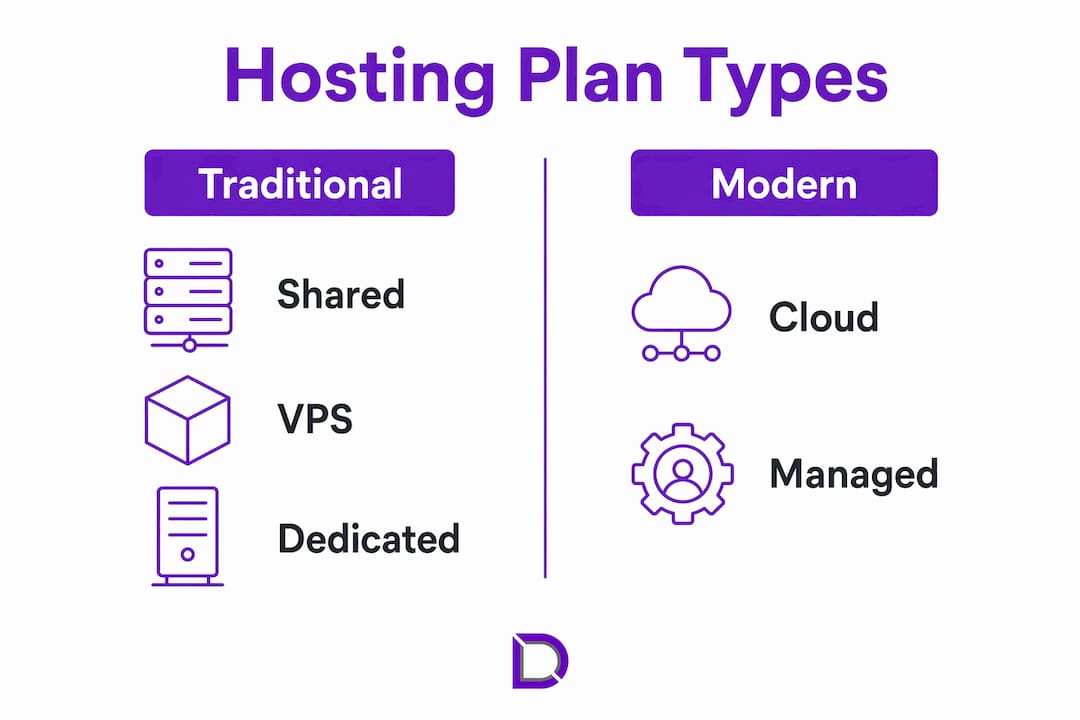
Cloud hosting distributes your site across multiple servers, so if one fails, another takes over. Cloud plans start around $5 per month but vary widely based on actual resource consumption. The elasticity makes cloud hosting excellent for sites with unpredictable or seasonal traffic spikes.
Managed hosting is the most hands-off option. The provider handles server configuration, security patches, updates, and performance tuning. Managed WordPress hosts like Kinsta and WP Engine include server optimisations and CDN integration, and prices start around $29 to $30 per month. For business owners who want to focus on running their business rather than managing servers, this is often the smartest investment. You can explore managed hosting benefits in more detail to understand what the provider takes off your plate.
How does your hosting plan affect SEO and site speed?
Hosting is not just an infrastructure decision. It is an SEO decision. Hosting directly affects server response time (TTFB), which influences Core Web Vitals like Largest Contentful Paint (LCP). Google uses Core Web Vitals as a ranking factor, which means a slow server can suppress your search visibility regardless of how good your content is.
The mechanism is straightforward. When a visitor loads your page, their browser first waits for the server to respond. That wait time is TTFB. On a shared plan under load, your TTFB can spike because CPU and RAM are being consumed by other sites on the same server. Frontend optimisation alone won’t fix slow backend response under real traffic. You can compress images and minify code all day, but if your server is queuing requests, LCP will still underperform.
VPS and managed hosting provide more stable, consistent backend response times because resources are not shared. For a small business where the website generates leads or sales, the SEO benefit of faster TTFB justifies the additional monthly cost.
“Investing in VPS or managed hosting offers better performance stability and SEO advantages worth the higher monthly cost for small business websites.” — Web Hosting and SEO: The Complete Guide (2026)
Pro Tip: Use Google’s PageSpeed Insights to test your current TTFB. If it consistently reads above 600ms, your hosting plan is the most likely culprit, not your theme or plugins.
What does a hosting plan actually cost beyond the advertised price?
The advertised price on a hosting plan is almost never the price you will pay long term. Introductory hosting prices are often much lower than renewal rates, and the effective cost over one to three years can be substantially higher once the promotional period ends. Treat introductory and renewal pricing as two separate products when you compare providers.
To calculate the true cost of a hosting plan, work through these considerations in order:
- Renewal rate: Find the standard renewal price, not the sign-up price. Some providers triple their rate after the first term.
- Domain registration: Many plans advertise a free domain for year one, but renewal of that domain adds $15 to $25 per year from year two onward.
- Email hosting: Business email is sometimes included, sometimes sold separately. Confirm before committing.
- SSL certificate: Basic SSL is usually free via Let’s Encrypt, but premium SSL for e-commerce may cost extra.
- Backup fees: Some providers charge separately for daily or on-demand backups. Without frequent backups, manual fixes after errors become risky and costly.
- Migration fees: Moving your site from another host can cost $50 to $200 if the provider does not offer free migration.
- Staging environments: Useful for testing changes before they go live, but not always included in base plans.
The cheapest hosting plan rarely stays cheapest once you account for these additions. A plan at $3 per month with paid backups, paid email, and a high renewal rate can easily cost more over two years than a $15 per month plan that includes everything.
How to choose the right hosting plan for your website
Choosing a hosting plan comes down to matching your current needs with a plan that has room to grow. Most small business owners either underbuy (choosing shared hosting that limits performance) or overbuy (paying for dedicated resources they will not use for years).
Start by assessing these factors honestly:
- Current and expected traffic: A new site with under 500 visitors per month is fine on shared hosting. A site generating leads daily needs VPS or managed hosting.
- Technical comfort level: If you are not comfortable with server management, managed hosting removes that burden entirely. The benefits of managed hosting services include automatic updates, security monitoring, and expert support.
- Scalability: Choose a provider that lets you upgrade your plan without migrating to a new server. Forced migrations are disruptive and sometimes costly.
- Security and compliance: If you collect customer data or process payments, your hosting plan must include SSL, firewalls, and regular backups as standard.
- Support quality: Australian small businesses benefit from local support that operates in compatible time zones. A provider with 24/7 live chat is worth more than one with ticket-only support when your site goes down on a Friday afternoon.
Pro Tip: Plan your hosting upgrade before you need it, not after. Traffic spikes from a campaign or media mention will expose a weak hosting plan at the worst possible moment. Upgrade proactively when your site starts generating consistent revenue.
For a deeper look at how different architectures support growth, the guide on scalable hosting for small businesses is worth reading before you commit to a plan.
Key takeaways
A hosting plan is the single infrastructure decision that affects everything else about your website, from search rankings to customer trust to long-term cost.
| Point | Details |
|---|---|
| Hosting plan definition | A hosting plan bundles server resources and services that keep your website online and performing. |
| Types matter for performance | Shared hosting suits small sites; VPS and managed hosting deliver better speed and SEO results. |
| True cost is higher than advertised | Always calculate renewal rates, domain, email, and backup fees before committing to a plan. |
| Hosting directly affects SEO | Server response time (TTFB) influences Core Web Vitals, which Google uses as a ranking factor. |
| Plan for growth upfront | Choose a scalable plan and upgrade before traffic spikes, not after performance problems appear. |
Why I think most small businesses get their hosting decision backwards
Most small business owners treat hosting as an afterthought. They spend weeks choosing a website theme and hours writing their About page, then spend three minutes picking the cheapest hosting plan available. That order of priorities is backwards.
Your hosting plan is the foundation everything else sits on. A beautiful website on a slow shared server will lose visitors before they read a single word. Google’s Core Web Vitals scoring will suppress it in search results. And when something goes wrong, which it will, a cheap plan with no backups and ticket-only support turns a one-hour fix into a two-day crisis.
What I have seen work consistently for small business owners is starting on a quality managed or VPS plan from day one, even if the site is small. The performance headroom means you are not scrambling to migrate when traffic grows. The included backups mean a plugin conflict or a bad update does not cost you a week of work. And the support means you have someone to call who actually knows your setup.
The other mistake I see regularly is ignoring renewal pricing. A plan that looks affordable at sign-up can double or triple in cost at renewal. Calculate the two-year total cost before you commit, not the monthly teaser rate.
Hosting is not glamorous. But getting it right from the start is one of the highest-return decisions you will make for your website.
— James
Get your website on solid ground with Com
Com offers web hosting plans built specifically for Australian individuals and small businesses, with local support that understands your context and your time zone. Every plan includes security features, automated backups, and scalable resources so your site performs well from day one and grows without painful migrations.
Whether you are launching your first website or moving away from a plan that has been holding you back, Com’s team provides personalised guidance to match you with the right hosting package. You can also manage your domain registration alongside your hosting for a complete, coordinated online presence. Reach out to Com to find a plan that fits your site today and scales with your business tomorrow.
FAQ
What does a hosting plan include?
A hosting plan includes server storage, bandwidth, CPU and RAM resources, security features like SSL and firewalls, and typically customer support. Many plans also include automated backups, email hosting, and a control panel for site management.
What is the difference between shared and managed hosting?
Shared hosting places your site on a server with many others, sharing resources at a low cost of $2 to $10 per month. Managed hosting gives you a dedicated technical environment where the provider handles updates, security, and performance, starting from around $29 to $30 per month.
Does my hosting plan affect my Google rankings?
Yes. Hosting affects server response time (TTFB), which influences Core Web Vitals like Largest Contentful Paint. Google uses Core Web Vitals as a ranking signal, so a slow hosting plan can directly reduce your search visibility.
How do I know when to upgrade my hosting plan?
Upgrade when your site consistently experiences slow load times under normal traffic, when your TTFB exceeds 600ms in Google PageSpeed Insights, or when your business starts generating regular revenue that depends on website performance.
Why is the advertised hosting price different from what I actually pay?
Providers use introductory rates that are significantly lower than renewal prices. Additional costs for domain registration, email, backups, and migration fees also apply. Always calculate the full two-year cost before choosing a plan.
Leave a Reply