




A web hosting provider is a company that stores your website’s files on servers and makes your site accessible to anyone on the internet, at any time. Without a host, your website simply does not exist online. Think of it like renting space in a building: your files live on the provider’s servers, and every time someone types your domain name, those files are delivered to their browser in seconds. For small business owners and individuals, understanding what a web host does is the difference between treating hosting as a throwaway expense and recognising it as the foundation your entire online presence is built on.
What does a web hosting provider do, exactly?
A web hosting provider does far more than store files. The core job is to keep your website online, fast, and secure around the clock, which involves a wide range of technical and operational responsibilities that most site owners never see.
Here is what a provider actively manages on your behalf:
- Server management and hardware maintenance. Physical servers need monitoring, cooling, and regular hardware checks. Your provider handles all of this so your site stays live without you lifting a finger.
- Network stability and uptime monitoring. Providers watch their networks continuously, rerouting traffic and fixing faults before they cause outages. Reliable hosting environments include server redundancy, automated backups, and monitoring systems that detect problems early to prevent downtime. This means a good provider is actively working to keep your site up even when things go wrong.
- Security features. SSL certificates, firewalls, malware scanning, and DDoS protection are standard offerings from quality providers. These protections shield your visitors’ data and your business reputation.
- Data backups and recovery. If something breaks or gets hacked, a provider with automated backups can restore your site quickly. You can read more about backup best practices for small business websites to understand what to look for.
- Software updates and patch management. Servers run operating systems and software that need regular updates to stay secure. Managed providers handle this automatically.
- Customer support and technical assistance. When something breaks, you need someone to call. Quality providers offer 24/7 support via phone, chat, or email.
The distinction between managed and unmanaged hosting matters here. Managed hosting services handle updates, security, and optimisation so site owners can focus on content and business activities. Unmanaged hosting gives you more control but places the technical burden squarely on you.
Pro Tip: If you do not have a dedicated IT person, managed hosting is almost always the smarter choice. The time you save troubleshooting server issues is worth far more than the price difference.
What are the main types of web hosting?
Choosing a hosting provider starts with understanding the four main service models. Each suits a different stage of business growth, budget, and technical need.
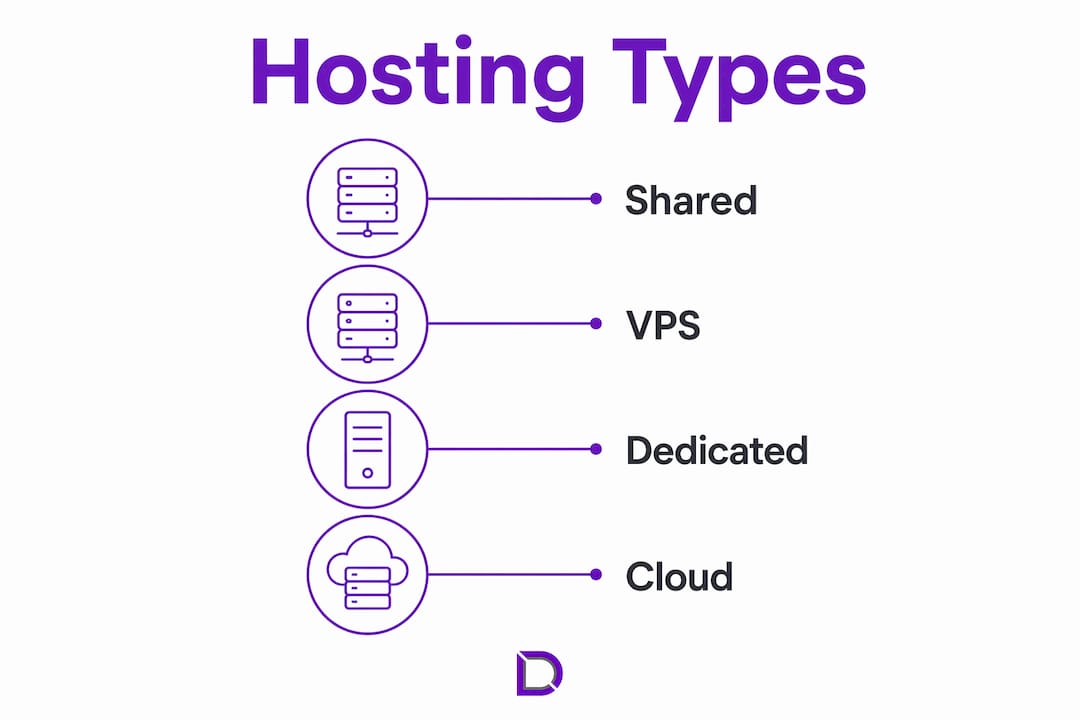
Shared hosting is the entry point for most individuals and new small businesses. Your website shares server resources with hundreds of other sites. Entry-level shared hosting typically costs between £5 and £15 per month as of 2026, but requires business owners to manage their own security and backups in many cases. That low price comes with trade-offs: slower speeds during peak traffic and limited control over your environment.
Virtual Private Server (VPS) hosting gives you a dedicated slice of a shared server. You get more resources, better performance, and greater control than shared hosting, without the cost of a full dedicated machine. VPS suits growing businesses that have outgrown shared hosting but do not yet need enterprise-level infrastructure.

Dedicated server hosting means the entire physical server is yours. This delivers maximum performance, control, and security. It is the right choice for high-traffic sites, e-commerce businesses handling sensitive data, or any operation where downtime carries a serious financial cost.
Cloud hosting uses a network of servers rather than a single machine. Cloud hosting improves uptime, performance, scalability, and security by distributing load across multiple servers. This means if one server fails, another picks up the slack instantly. For Australian small businesses expecting growth, cloud hosting offers the flexibility to scale resources up or down without migrating to a new plan.
| Hosting type | Best for | Cost level | Control level |
|---|---|---|---|
| Shared hosting | Individuals, new sites | Low | Low |
| VPS hosting | Growing small businesses | Medium | Medium |
| Dedicated server | High-traffic, e-commerce | High | High |
| Cloud hosting | Scalable, growing businesses | Medium to high | Medium to high |
| Managed hosting | Non-technical site owners | Medium | Low (provider manages) |
For a deeper comparison tailored to Australian businesses, the guide on types of hosting plans covers each model in practical detail.
Why does your hosting provider affect performance and security?
The quality of your hosting provider has a direct and measurable impact on your business outcomes, not just your server speed.
Web hosting impacts SEO through server response times, uptime, site stability, and page load speed, influencing search engine rankings and visibility. Google treats slow, unreliable sites as poor user experiences and ranks them lower. A business that invests in quality hosting is effectively investing in organic search performance.
Security is the other critical dimension. Poor hosting environments leave your site exposed to malware, data breaches, and ransomware. For small businesses collecting customer information, a breach is not just a technical problem. It is a legal and reputational one. Quality providers include SSL certificates, firewall protection, and regular security audits as standard.
“Hosting providers act as foundational sales engines and customer support desks, underpinning all visitor interactions and transactions on a website.” — Mark Bryce, founder of SME AI Consultancy
That framing from Mark Bryce is worth sitting with. Every page load, every product purchase, every contact form submission runs through your hosting environment. Reliable hosting ensures faster load times, better search engine rankings, and higher conversion rates by supporting stable and secure website environments. The cost of downtime, whether measured in lost sales, damaged trust, or emergency repair fees, almost always exceeds the cost of choosing a better provider from the start.
Cheap shared hosting sacrifices essential support and performance, creating hidden risks for businesses lacking expertise to manage server security and updates. This is not a theoretical risk. It is the most common mistake small business owners make when they treat hosting as a commodity purchase.
How to choose a web hosting provider for your needs
Selecting the right provider comes down to matching your current needs with a service that can grow with you. Follow these steps to make a sound decision.
- Define your budget and website size. A personal blog has different requirements to an online store processing daily transactions. Be honest about your traffic expectations and the complexity of your site.
- Assess your technical skills. If you are not comfortable managing server settings, security patches, or database configurations, choose a managed hosting plan. The benefits of managed hosting are especially clear for small business owners without in-house IT support.
- Check uptime guarantees. Look for providers that offer a 99.9% uptime guarantee backed by a service level agreement. Anything below this is a warning sign.
- Review security inclusions. Confirm that SSL certificates, automated backups, and malware scanning are included, not sold as expensive add-ons.
- Test customer support before you commit. Send a pre-sales question and measure response time and quality. For Australian businesses, local support matters. A provider based in Australia understands your operating hours, compliance context, and business environment.
- Plan for growth. Choose a provider that offers scalable hosting architectures so you can upgrade your plan without migrating your entire site to a new server.
Pro Tip: Avoid choosing a provider based on price alone. Alan Carr, founder of Webpop Design, warns that very low-cost hosting often strips out the support and performance features that protect your business. The cheapest plan frequently becomes the most expensive mistake.
Key takeaways
A web hosting provider is a strategic business asset that directly shapes your website’s speed, security, search rankings, and ability to serve customers reliably.
| Point | Details |
|---|---|
| Core function of a provider | Stores your website files on servers and keeps your site accessible online at all times. |
| Managed vs unmanaged hosting | Managed hosting handles security, updates, and backups for you, reducing technical risk. |
| Hosting types and fit | Shared suits beginners; VPS and cloud suit growing businesses; dedicated suits high-traffic sites. |
| Hosting affects SEO and sales | Server speed, uptime, and stability directly influence search rankings and conversion rates. |
| Choosing wisely | Prioritise uptime guarantees, security inclusions, local support, and scalability over low price. |
Hosting is not a background expense. It is your business infrastructure.
I have spoken with dozens of small business owners who discovered the hard way that their hosting provider was the weakest link in their operation. They had invested in professional design, solid content, and paid advertising, but their site was slow, went down without warning, and had no backups in place. When a hack hit, there was nothing to restore.
The conventional wisdom is to start cheap and upgrade later. My experience says the opposite. The businesses that treat hosting as a strategic business investment from day one spend less over time. They avoid emergency recovery costs, they rank better in search results, and their customers trust them more because the site is always fast and always up.
There is also a subtler point worth making. Your hosting provider is the silent partner in every customer interaction your website handles. When someone visits your site at 11pm to check your opening hours or place an order, your hosting environment is doing the work your team cannot. That is not a technical detail. That is your business operating without you.
Small businesses in Australia often underestimate the value of local support. When something goes wrong at 9am on a Monday before a product launch, you want someone who picks up the phone and understands your context, not a generic offshore helpdesk ticket system. That local knowledge and responsiveness is a genuine competitive advantage.
Invest in hosting that matches your ambitions, not just your current budget.
— James
Get your website online with Com
Com provides web hosting built for Australian individuals and small businesses, with personalised local support that larger providers simply do not offer. Whether you are launching your first site or moving away from a provider that has let you down, Com’s hosting plans are designed to keep your site fast, secure, and online.
Pair your hosting with professional domain management to keep your entire online presence organised in one place. Com’s team is available to help you choose the right plan for your needs, your budget, and your growth goals. Reach out today and get your business online with confidence.
FAQ
What does a web hosting provider do?
A web hosting provider stores your website’s files on servers and makes your site accessible to visitors on the internet. Beyond storage, providers manage server security, uptime monitoring, data backups, and technical support.
What is the difference between managed and unmanaged hosting?
Managed hosting means the provider handles security, updates, and backups on your behalf, while unmanaged hosting gives you full control but requires you to manage those tasks yourself. Most small businesses benefit from managed hosting to reduce technical risk.
How does hosting affect my website’s SEO?
Hosting quality directly influences SEO through server response times, uptime, and page load speed, all of which are signals Google uses to rank websites. A slow or unreliable host can suppress your search rankings regardless of your content quality.
Which type of hosting suits a small business?
Shared hosting suits new or low-traffic sites due to its low cost, while VPS or cloud hosting better suits growing businesses that need more performance and reliability. Managed hosting is the practical choice for business owners without technical expertise.
Is cheap hosting a risk for my business?
Yes. Low-cost hosting plans frequently omit critical features like automated backups, security monitoring, and responsive support, leaving your site exposed to outages and attacks. The cost of recovering from a breach or extended downtime almost always exceeds the savings from a cheap plan.
Leave a Reply